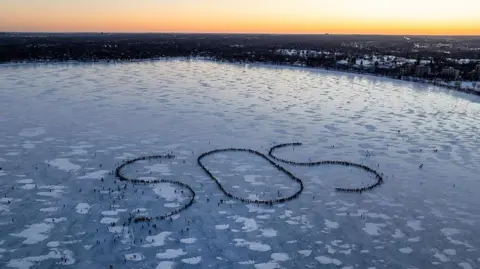
District Court Judge Katherine Menendez denied Minnesota's request to block the Trump administration's deployment of roughly 3,000 ICE and CBP agents to Minneapolis, finding the state had not proved the surge unlawful while acknowledging the operation's "profound" harms. The ruling occurs amid nationwide protests and public outcry after two Minneapolis residents, Renee Good and Alex Pretti, were shot by federal agents; the DOJ has opened a civil-rights investigation into Pretti's death and state and local officials have urged federal withdrawal.
Market structure: The immediate beneficiaries are vendors and contractors that supply detention, surveillance and domestic-security services (private prisons GEO, CXW; homeland IT/ops contractors LDOS, CACI, PLTR) and short-term demand for additional local security spending. Losers are municipal revenue in Minneapolis/St. Paul (retail footfall, hospitality) and reputationally exposed service providers; expect local municipal credit spreads to widen 5–25bp if protests persist beyond 2–4 weeks. Cross-asset: modest safe-haven flows into Treasuries and gold (+1–3%) during intense protests; USD/FX reaction should be muted absent national escalation.
Risk assessment: Tail risks include (A) DOJ civil-rights findings within 30–90 days triggering federal contracting freezes or fines, and (B) escalation to multi-city unrest that forces broader retail closures — both could depress stocks tied to enforcement or local economies by 15–40% in stressed scenarios. Hidden dependencies: federal contract flow depends on DHS budget decisions and internal audits (watch DHS solicitations); litigation and state-level legal rulings can reverse upside for contractors quickly. Key catalysts: DOJ investigation milestones (initial findings in 30–60 days), DHS procurement awards (weekly), and any state court rulings; election cycle policy shifts are 6–18 months out.
Trade implications: Tactical long exposure to private-detention and homeland-security names for a 3–6 month window, size-limited because reputational/regulatory risk is high; use defined-risk options to cap downside. Hedge municipal-credit exposure to Minnesota via overweight short-duration muni protection or buying 1–3 month protection in muni bond ETFs if protests persist >2 weeks. Use 1–2% portfolio-sized gold or VIX call positions as tactical hedges for sudden market-volatility spikes.
Contrarian: Consensus will assume uniform contractor upside; that underprices regulatory/legal reversal risk — after DOJ findings historically (e.g., post-scandal probes) contractors can lose 25–50% quickly. A less-obvious play: if DOJ tightens oversight, short-term contractors with high revenue concentration in ICE/CBP (small caps) are more exposed than diversified primes (LDOS, CACI). Historical parallel: post-9/11 security spend was front-loaded then normalized over 12–24 months; expect any rally to be similarly front-loaded and mean-reverting.
AI-powered research, real-time alerts, and portfolio analytics for institutional investors.
Request DemoOverall Sentiment
moderately negative
Sentiment Score
-0.40
