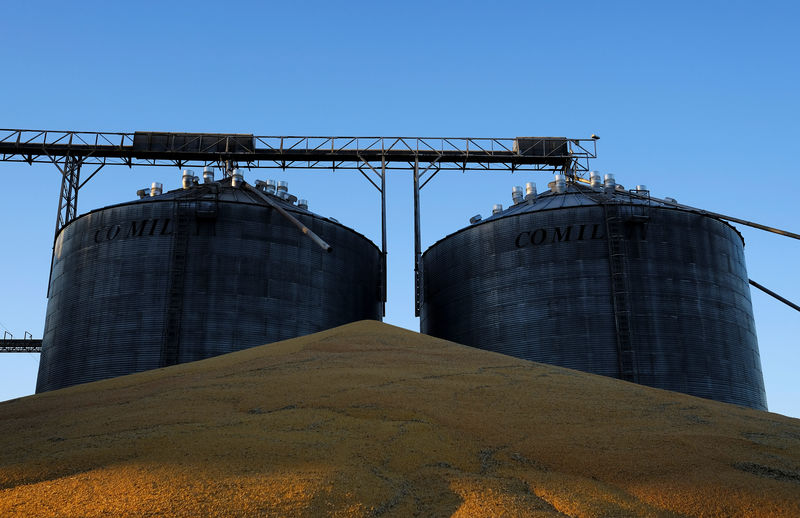
US corn futures jumped 4.70% to 476.38 after the White House formalized China’s pledge to buy at least $17 billion of U.S. agricultural products annually in 2026-2028, plus existing soybean commitments. The implied total U.S. farm imports from China could rise to roughly $28 billion-$30 billion per year, far above last year’s $8 billion, more than offsetting ample USDA supply forecasts. The move reversed a late-week selloff and pushed futures back above the 50-day moving average, though prices remain below the 52-week high of 487.5.
The immediate winner is not just ags but the entire implied-volatility complex around trade-sensitive commodities. A credible multi-year offtake path from the world’s largest importer reduces the probability of another abrupt demand shock, which matters more for positioning than for near-term fundamentals because managed money was likely leaning short after the post-summit disappointment. In that setup, the first move can overshoot; the second move is whether commercial buyers step back in and convert the headline into a durable restocking cycle.
The bigger second-order effect is relative value across the grain curve and across input-sensitive sectors. If China is truly re-entering U.S. ags at scale, the winners are the adjacent logistics, river, rail, and export-handling names, while domestic livestock margins could compress if feed costs stay elevated without a matching move in finished protein prices. A sustained corn rally also tightens the cost stack for ethanol and some packaged-food inputs, so the trade is not “long commodities” in the abstract; it is long upstream pricing power and short downstream margin absorbers.
The contrarian risk is that this is a headline-rich but implementation-light commitment: purchases can be temporized, redirected across crop categories, or satisfied through timing shifts rather than incremental spot demand. If the market starts pricing a clean line from pledge to actual imports, any failure to see follow-through in weekly export inspections or Chinese customs data over the next 4-8 weeks could unwind the move quickly. Seasonally, corn has room to mean-revert if weather and USDA supply assumptions remain benign, so the asymmetry is strongest on tactical momentum rather than a full-year re-rating.
The equity-market angle is more interesting than the macro headline suggests: a pro-trade impulse can lift cyclicals and transports even if the S&P is flat, but only if the market believes de-escalation reduces policy tail risk. If this is merely a one-off purchase promise, equity investors may fade it; if it signals a broader détente, the effect could extend to multinational industrials and Asia-exposed semis over 1-3 months.
AI-powered research, real-time alerts, and portfolio analytics for institutional investors.
Request DemoOverall Sentiment
moderately positive
Sentiment Score
0.62
Ticker Sentiment
