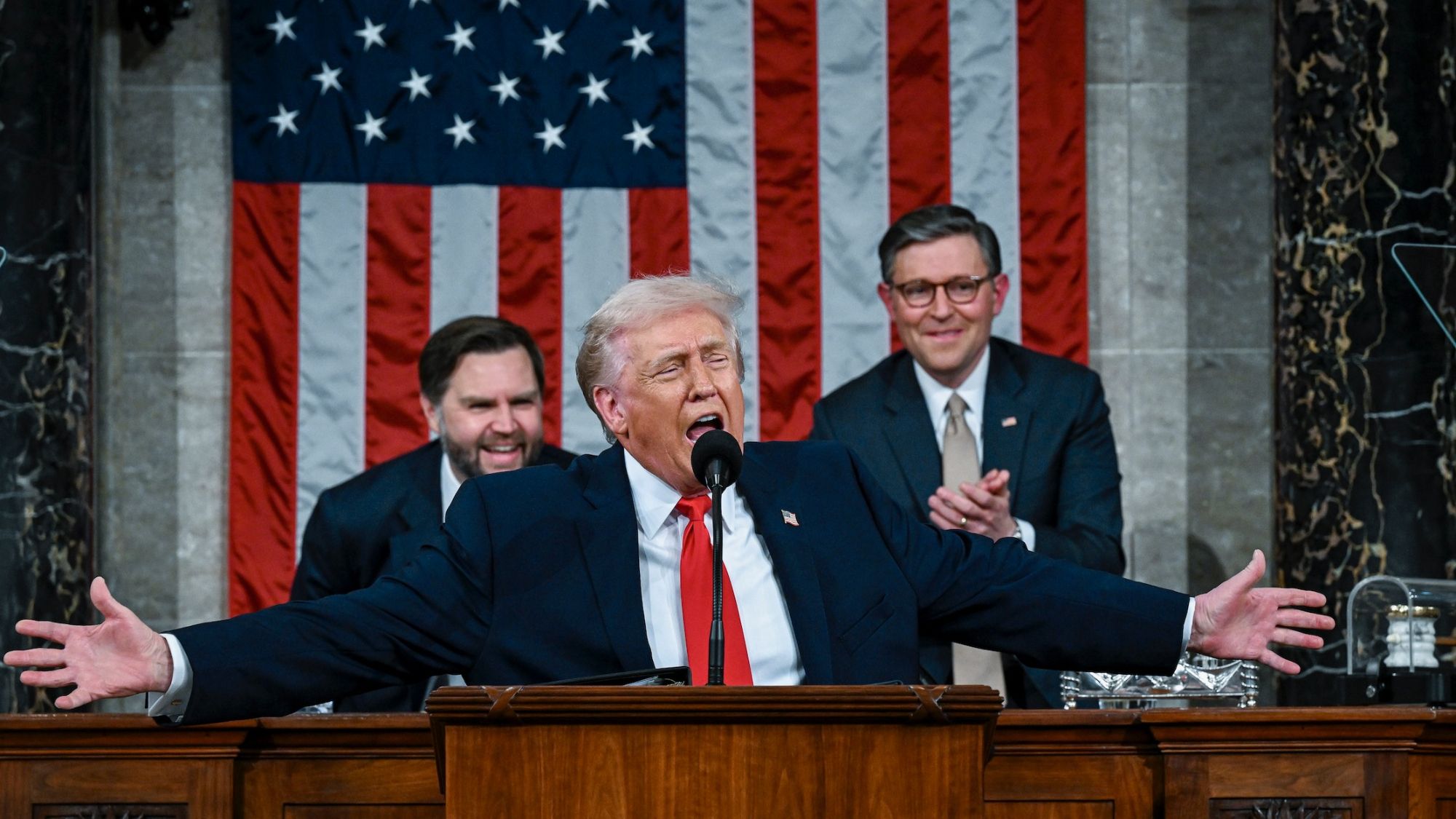
In a record 107-minute State of the Union, President Trump prominently praised the U.S. Space Force—calling it “my baby”—but did not mention NASA's upcoming Artemis 2 crew despite the four astronauts (Reid Wiseman, Victor Glover, Christina Koch and Jeremy Hansen) attending as guests. Separately, NASA has delayed the Artemis 2 launch after identifying a glitch with the Space Launch System that will require a rollback to the vehicle for troubleshooting, pushing the earliest liftoff from an intended March 6 window to April 1. The speech underscores continued political support for military space initiatives even as civilian lunar program schedules slip, a dynamic that could matter for defense and aerospace contractors' program timing and government prioritization.
Market structure: Trump's public embrace of the Space Force (and omission of Artemis 2) favors defense primes and space systems integrators that win DoD contracts (Lockheed LMT, Northrop NOC, Raytheon RTX, L3Harris LHX) rather than NASA-centric civil suppliers; the Artemis 2 SLS rollback to Apr 1 is a short-term revenue/timing hit for SLS suppliers (Boeing BA, LHX) but not a structural demand shock. Competitive dynamics shift incremental share toward military satellite, ISR and launch-on-demand suppliers rather than commercial human-spaceflight services; pricing power for primes remains intact given oligopolistic procurement. Supply/demand: near-term supply-side troubleshooting (SLS rollback) creates scheduling risk and potential backlog that benefits contractors with diversified portfolios; long-term demand for military space systems is likely to grow at a mid-single-digit CAGR if DoD budgets hold.
Risk assessment: Tail risks include a major SLS mission failure (technical) or a geopolitical crisis that forces immediate reallocation of budgets (operational/regulatory), each causing >20% swings in exposed stocks within days. Time horizons: immediate (days) – muted market reaction to SOTU; short-term (weeks–months) – Artemis troubleshooting updates, DoD budget release (next 30–90 days); long-term (years) – institutionalization of Space Force and multiyear procurement. Hidden dependencies: NASA funding dependency on Congress and single-source contracts (Boeing core stage, Aerojet components via LHX) create concentration risk; catalysts include DoD FY release, NASA anomaly reports, and congressional appropriations votes.
Trade implications: Tactical longs into defense primes and space ETFs with defined sizing and hedges: prioritize LMT/RTX/NOC and ARKX/LHX for space-exposure, and use options to cap downside around program risk. Pair trades: long military-focused prime vs short commercial aviation/leisure-exposed BA to isolate government-funded growth. Options: 6–9 month call spreads to capture upside from budget approvals while limiting premium decay; size to 0.5–2% portfolio risk per trade.
Contrarian angles: Consensus underweights small-cap specialized space services (satellite ops, propulsion SMEs) that could see outsized re-competes and subcontract awards if DoD pushes rapid fielding; defense primes' valuations already price political support, so upside may be limited while small-caps are underpriced. Historical parallel: post-Apollo defense spending spikes were followed by multi-year mean reversion when budgets normalized — expect similar risk if fiscal constraints bite. Unintended consequences: politicization of Space Force procurement increases program volatility and repricing risk for single-source contractors.
AI-powered research, real-time alerts, and portfolio analytics for institutional investors.
Request DemoOverall Sentiment
neutral
Sentiment Score
0.00
