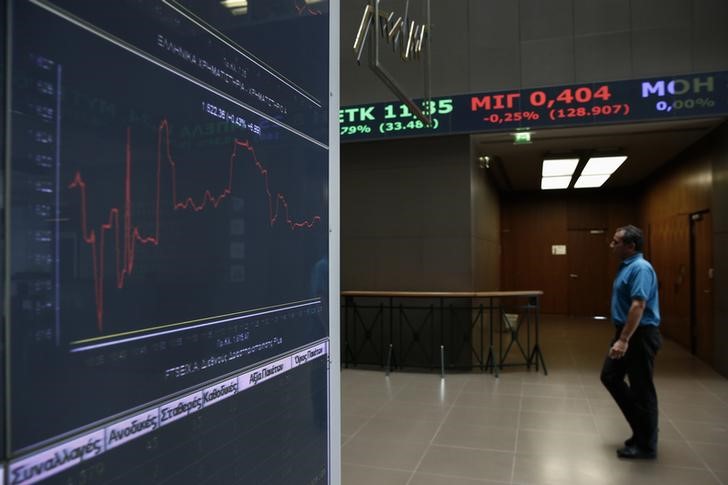
Athens General Composite rose 1.25% at the close, driven by gains in Banking, Construction and Travel sectors; top performers included Lavipharm (+5.59%), Kri‑Kri Milk (+5.47%) and Allwyn AG (+4.05%) while Fais Symmetochon fell 4.29%. Commodity moves: June gold futures down 0.21% to $4,674.75/oz, May crude oil up 3.10% to $115.90/bbl and June Brent up 0.48% to $110.30/bbl. FX: EUR/USD around 1.16 and the US Dollar Index futures down 0.15% at 99.65. Overall a routine market close report with modest sector and commodity moves unlikely to trigger broad market dislocations.
Geopolitical-driven energy premiums and higher commodity-price volatility are an under-acknowledged tax on the marginal economics of AI deployments: higher power and logistics costs raise the total cost of ownership for small-to-midscale AI buyers and make scale/contracted-power economics material. That creates a structural advantage for suppliers who sell to hyperscalers or who can deliver full-system solutions with shorter lead times — a two- to nine-month sales-conversion runway advantage versus component-only vendors.
For mobile ad platforms, cyclical downdrafts in discretionary spend and a flight-to-safety in investor flows will compress top-line growth faster than headline macro prints show, because user acquisition costs and CPI-sensitive ad budgets move immediately while monetization lags. Conversely, pockets of the travel/booking ecosystem will see concentrated, idiosyncratic upside if consumers reallocate saved travel budgets — that divergence raises dispersion and alpha opportunity across the internet-advertising complex over the next 1–3 quarters.
Immediate tail risks that could reverse current positioning include a short sharp geopolitical escalation (days–weeks) that spikes oil, banks reprice corporate liquidity (weeks), or new export controls on AI hardware (1–3 months) that choke incremental shipments. Over 6–18 months the most likely mean reversion paths are: normalization of freight/power costs (benefiting smaller buyers), or sustained higher energy forcing consolidation toward large-scale buyers and vertically integrated sellers. Key trackers: hyperscaler capex cadence, freight lead times, and power contract repricing timelines — these will determine who captures real incremental margin.
AI-powered research, real-time alerts, and portfolio analytics for institutional investors.
Request DemoOverall Sentiment
neutral
Sentiment Score
0.00
Ticker Sentiment
