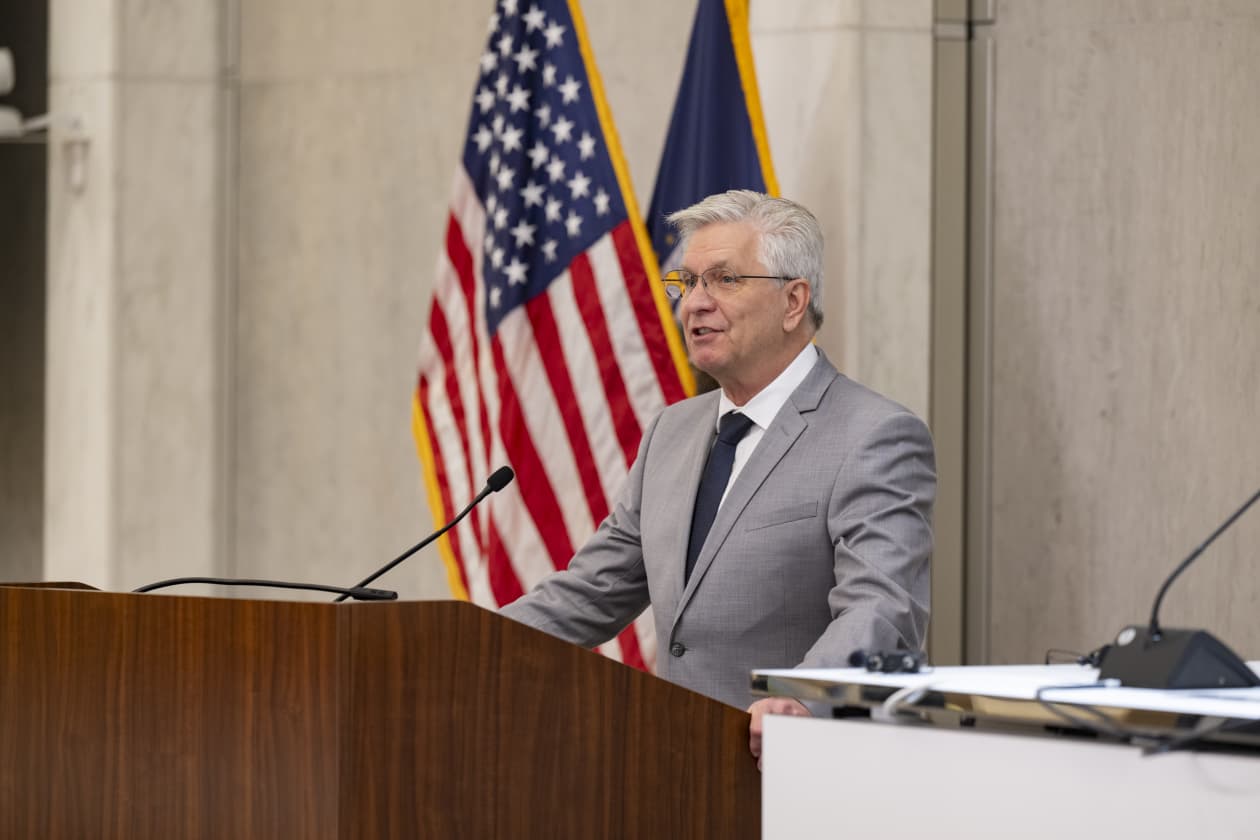
Federal Reserve Governor Christopher Waller strongly advocated for an interest rate cut this month, asserting the labor market is significantly weaker than perceived, citing private-sector job growth near 'stall speed' with only 74,000 jobs added in June. He further contended that tariffs are not a lasting inflation concern, being one-off price increases largely absorbed by foreign suppliers. This contrasts sharply with the majority of Fed officials, who describe the labor market as healthy and prefer to await further inflation data, and with current market expectations for a July cut, underscoring a notable policy divergence within the FOMC.
Federal Reserve Governor Christopher Waller is making a distinct case for a July interest rate cut, a position that starkly contrasts with the FOMC consensus and current market pricing. His argument is twofold: the labor market is weaker than perceived, with private-sector job additions slowing to 74,000 in June, a level he describes as near 'stall speed and flashing red'; and tariff-related inflation is a 'one-off' event that will not create a sustained upward spiral, with underlying inflation already near the 2% target. This dovish stance is directly opposed by influential members like New York Fed President John Williams, who views the labor market as 'solid' and tariffs as an inflationary risk. The market has sided with the consensus, with derivative traders pricing in a minimal chance of a July cut. The divergence is notable as Waller and Governor Bowman, the only two officials publicly supporting a near-term cut, are both Trump appointees, adding a political dimension to the policy debate.
AI-powered research, real-time alerts, and portfolio analytics for institutional investors.
Overall Sentiment
mildly negative
Sentiment Score
-0.30
