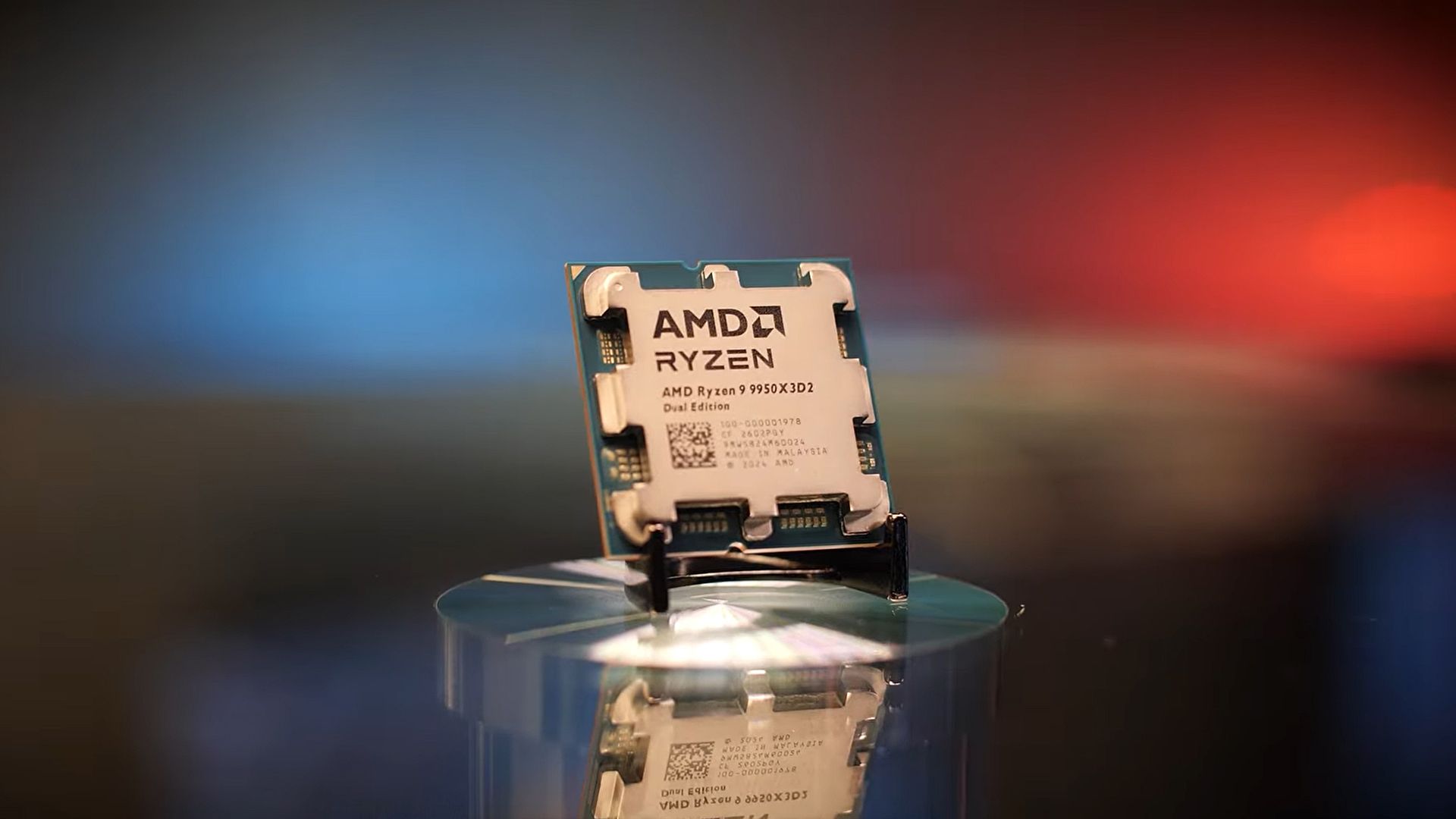
AMD priced the new Ryzen 9 9950X3D2 at $899 MSRP (a $200 premium vs. the Ryzen 9 9950X3D) and will ship to retailers on April 22. The Zen 5 X3D 16-core/32-thread CPU uses dual 3D V-Cache for 208MB total cache, 4.3/5.6GHz clocks and a 200W TDP, and is marketed toward developers and content creators; AMD cites up to +13% in SPECWorkstation data science workloads and ~5–8% gains in other applications. Gaming uplift is expected to be minimal due to inter-CCD latency, so the product primarily reinforces AMD's high-end workstation pricing rather than shifting broader market dynamics.
AMD’s dual–cache SKU is less about incremental unit volume and more about mix engineering: a high-ASP, low-volume halo can lift company-wide ASPs and gross margins disproportionately if OEMs and creators adopt it as a workstation alternative to TR/EPYC. A 1–2% shift of desktop/workstation buyers into the premium SKU could translate into a measurable ASP lift (low-single-digit percent) and ~50–150bps of gross margin upside over 2–4 quarters, without needing broad consumer adoption.
Supply-side frictions are the most important second-order constraint. Dual 3D-stack packaging increases yield sensitivity, test time, and BOM (thermal solutions, power delivery), which concentrates incremental margin in packaging/test partners and could temporarily tighten available supply. That tightness makes initial sell-through an unreliable signal of long-term demand — sell-outs could reflect constrained supply rather than organic pull-through.
Competitively, this deepens AMD’s non-Intel-contested niche: customers who prioritize deterministic single-socket workstation latency and dataset locality have fewer alternatives today, pressuring Intel to fast-follow or discount. That puts a 3–12 month premium on AMD’s pricing power but also raises the probability of aggressive Intel responses (price or product) that compress industry margins once Nova Lake or Intel dual-cache variants ship.
Key near-term catalysts to watch are independent workstation benchmarks, OEM/system integrator SKUs and shipping volumes, and reported packaging yields; each will re-rate expectations quickly. Tail risks include persistent thermal/inter-CCD latency regressions or yield failures that force markdowns — both would unwind the halo premium inside one quarter if observed at scale.
AI-powered research, real-time alerts, and portfolio analytics for institutional investors.
Request DemoOverall Sentiment
neutral
Sentiment Score
0.00
Ticker Sentiment
