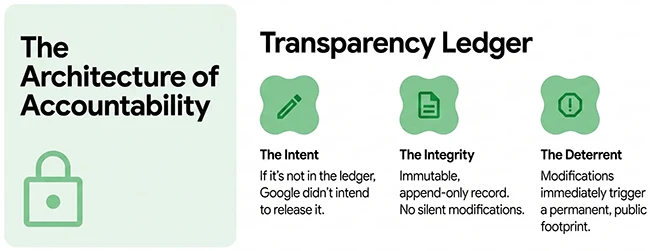
Google is expanding Android Binary Transparency for production apps released after May 1, 2026, adding a public append-only ledger to verify that software on devices matches what Google authorized. The program covers Google Applications and Mainline Modules, with Pixel users also able to cross-check system images via Pixel System Image Transparency. The initiative should improve supply-chain security and insider-risk detection, with Google also signaling plans to extend the framework to third-party developers.
This is a quiet but meaningful governance upgrade for GOOGL: it shifts the debate from “can Google sign software?” to “can Google prove which software it intended to ship?” That matters most for privileged Android components, where compromise risk is not just reputational but ecosystem-wide, because a malicious update could scale across billions of devices before traditional endpoint defenses notice. The second-order effect is reputational optionality: Google is trying to become the default trust anchor for Android software, which should modestly reduce perceived platform risk around payments, identity, and AI-enabled mobile workflows. The commercial benefit is more subtle than direct revenue. If third-party participation expands, Google could convert transparency into a de facto compliance standard, increasing switching costs for OEMs and app distributors while reinforcing the moat around Play Services and Android system layers. The likely near-term winner is the broader Android ecosystem’s security posture; the likely losers are smaller Android forks and gray-market app distributors that rely on opacity and slower patching cycles to compete. The key risk is adoption friction. Transparency only becomes economically meaningful if enterprises, regulators, and OEM partners treat log inclusion as a procurement or certification requirement; absent that, this remains a good security story with limited P&L impact. Another latent risk is insider-process failure inside Google itself: if a future incident shows a signed binary absent from the log, the narrative flips from deterrence to “paper control,” and the market would discount the credibility premium quickly. Contrarian take: the move may be underappreciated because the value is not in preventing every attack, but in lowering the probability of a catastrophic, trust-damaging supply-chain event. That tail-risk suppression supports a small but persistent multiple premium for GOOGL versus other mega-cap software platforms that lack comparable platform-level trust architecture. The upside, however, should be measured in basis points of valuation, not a rerating catalyst.
AI-powered research, real-time alerts, and portfolio analytics for institutional investors.
Request DemoOverall Sentiment
mildly positive
Sentiment Score
0.25
Ticker Sentiment
