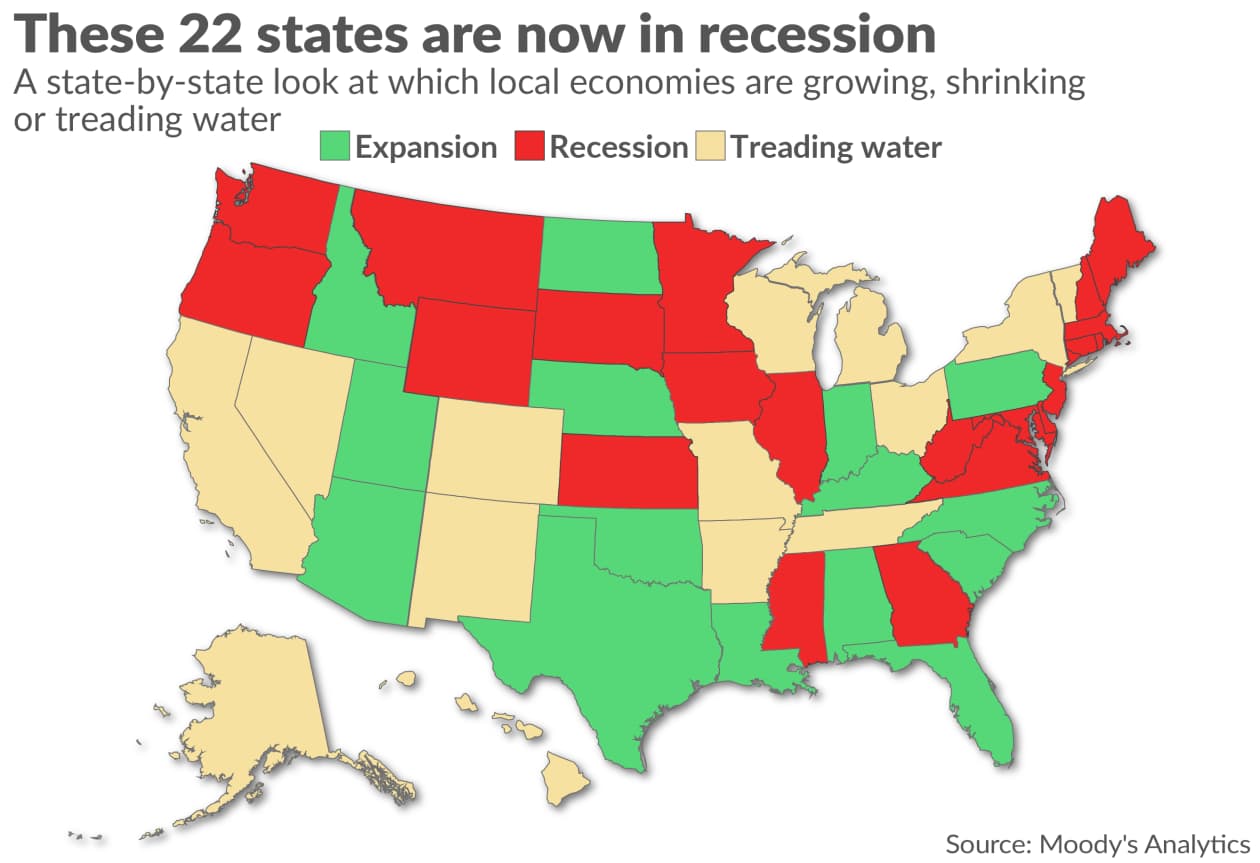
Mark Zandi of Moody's Analytics reports that 22 U.S. states and D.C. are already experiencing recessionary conditions, placing the national economy "on the precipice" of a damaging contraction, primarily due to White House tariffs, stagnant labor-force growth, and federal job cuts. While some economists cite strong Q3 GDP growth and robust consumer spending, Zandi emphasizes a weaker job market and struggling goods-producing sectors in these states, warning that a downturn in large states like California or New York could trigger a broader national recession.
Economic Outlook Are we in a recession? Yes — if you live in one of these 22 states. Moody’s economist Mark Zandi warns the U.S. is close to a damaging economic contraction The U.S. economy is very close to falling into a damaging contraction — and many states are already in a recession, according to Mark Zandi, chief economist at Moody’s Analytics. Zandi estimates that 22 states and the District of Columbia are now experiencing persistent economic weakness and job losses that are likely to continue. Another 13 states are treading water, he noted. The overall picture is one of a weak U.S. economy that is vulnerable to being pushed into a ditch by a strong wind. “The economy is still not in recession, but the risks are very high. We’re on the precipice,” Zandi said in an interview with MarketWatch. California and New York are among the states that are treading water. If either of those falter, it would tip the economy into recession, Zandi said. A separate forecast by UCLA Anderson School of Management released this week said that a recession in California is now plausible. According to Zandi, the cause of the weakness is economic policy. White House tariffs on imported goods have caused uncertainty, forcing companies to pull back from expansion plans and confusing supply chains. No labor-force growth this year has also hurt the economy. In addition, federal job cuts tied to the Trump administration’s Department of Government Efficiency, formerly led by Elon Musk, have pushed Washington D.C. and its surrounding states into the deepest downturn of any region. On a national level, the National Bureau of Economic Research defines a recession as a significant decline in economic activity that is spread across the economy and lasts more than a few months. The organization puts particular emphasis on a few indicators — including nonfarm-payroll employment, personal income adjusted for inflation excluding transfers, consumer spending adjusted for inflation, and industrial production. Zandi admits that identical data isn’t produced for state economies. He said he tries to replicate the NBER, but admits there is a fair amount of judgement in his conclusions. Zandi has given policy advice to congressional Democrats, but says he’s an independent who worked as a top adviser to the late Sen. John McCain when he ran for the Republican presidential nomination. The prevailing narrative among economists is that the U.S. economy’s expansion will continue, driven by consumer spending. Richard Moody, chief economist at Regions Bank, noted that third-quarter U.S. GDP growth is estimated to be rising at a 3.8% annual rate. The latest data on business investment, jobless claims and consumer spending have been decent, he added. “Nothing suggests the economy is rolling over,” Moody said in an interview. The most recent data released by the government before this week’s federal shutdown surprised to the upside and showed the broader economy was in pretty good shape. But Zandi said the latest data didn’t change his views. “GDP and consumer spending are stronger, but the job market is weaker,” he said. A common denominator of the states in recession is that they have weak farm economies or faltering light manufacturing. Any part of the country whose economies depends on goods-producing activities, agriculture, mining and light manufacturing are currently weak, Zandi said, adding that a weak transportation sector is exacerbating the downturn. The contraction in the New England region is not unusual because of its slow population-growth trends, according to Zandi. “That region doesn’t grow very strongly even in the best of times,” he said. But Zandi said he was surprised that Georgia is in recession. The state has seen a significant pullback in domestic immigration, in part because of high home values, he noted. Pennsylvania, meanwhile, is a surprise on the upside, he added, with the state benefitting from strength in education and healthcare. A significant divergence in U.S. economic outlooks has emerged, pitting a pessimistic state-level analysis against more robust national indicators. Mark Zandi of Moody's Analytics posits that the national economy is on the "precipice" of recession, with 22 states and the District of Columbia already experiencing recessionary conditions. He attributes this weakness to specific policy-driven factors, including White House tariffs that have created business uncertainty and supply chain disruptions, stagnant labor-force growth, and federal job cuts that have severely impacted the Washington D.C. regional economy. The downturn is reportedly concentrated in goods-producing sectors such as agriculture, mining, and light manufacturing, with transportation also showing weakness. In contrast, the prevailing view, articulated by Richard Moody of Regions Bank, points to strong consumer spending, a 3.8% estimated annual rate for third-quarter GDP growth, and decent recent data on business investment and jobless claims as evidence that the expansion will continue. Zandi counters this by arguing that strong GDP figures mask a deteriorating job market. The analysis highlights significant regional economic divergence, noting surprising weakness in Georgia tied to housing values and immigration, while Pennsylvania shows resilience due to its education and healthcare sectors. Zandi's methodology for state-level recession calls involves subjective judgment, a key factor for consideration, but the overall report underscores a fragile national economy where a downturn in bellwether states like California or New York could act as a catalyst for a broader contraction.
AI-powered research, real-time alerts, and portfolio analytics for institutional investors.
Request DemoOverall Sentiment
strongly negative
Sentiment Score
-0.65
Ticker Sentiment
