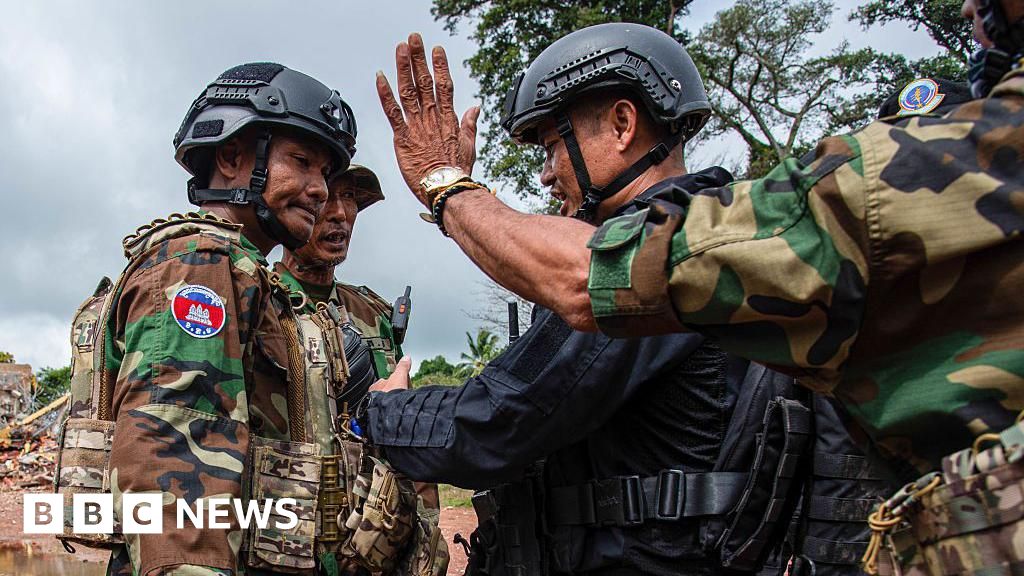
Heavy fighting has resumed along the Thai‑Cambodian border with artillery, rockets and air strikes forcing evacuations across a corridor of villages after a Sunday incident in which, according to the Thai army, Cambodian troops fired on a Thai engineering team—wounding two soldiers—underscoring that the July ceasefire brokered by President Trump was fragile. The ceasefire was reluctantly accepted by Thailand under U.S. tariff pressure while Cambodia welcomed outside intervention; since July Cambodian forces have continued confrontations and laid new land‑mines that have cost seven Thai soldiers limbs, Thailand has refused to release 18 soldiers captured in July, and Prime Minister Anutin’s minority government has given the military free rein to press for control of strategic hill positions. Former strongman Hun Sen’s continued influence—most notably through a leaked phone call that helped topple Thailand’s Paetongtarn Shinawatra government—has hardened Thai public opinion and reduced appetite for diplomacy, and Bangkok says it will not resume talks until Cambodia demonstrates sincerity, at minimum a verified end to land‑mine use, making any new Trump‑mediated ceasefire likely temporary without concrete verification.
Heavy fighting has resumed along the Thai–Cambodian border with artillery, rockets and air strikes forcing evacuations across a corridor of villages after a Sunday incident in which, according to the Thai army, Cambodian troops fired on a Thai engineering team and wounded two soldiers. The July ceasefire brokered by President Trump was fragile: Thailand accepted it under U.S. tariff pressure while Cambodia welcomed outside intervention, making the agreement politically asymmetric and short‑lived. The immediate spark and renewed evacuations show how tactical incidents can rapidly undo external mediation.
Since July Cambodian forces have continued confrontations and laid new land‑mines that the article says have caused seven Thai soldiers to lose limbs; Thailand has refused to release 18 soldiers captured in July. Prime Minister Anutin Charvirakul’s minority government has given the military carte blanche, and the army now seeks hill‑top positions and to inflict decisive damage on Cambodian units. Those operational objectives increase the probability of sustained kinetic exchanges rather than limited skirmishes.
Former strongman Hun Sen’s continued influence, including a leaked phone call that helped topple Thailand’s prior government, has hardened Thai public opinion and reduced appetite for diplomacy; Bangkok insists on a verified end to land‑mine use before new talks. The article’s facts and the theme outputs (geopolitics, domestic politics, defense, tariffs) imply elevated regional political risk; the provided sentiment is moderately negative with a market impact score of 0.28, suggesting modest but meaningful economic spillovers and a low probability of a durable resolution without independent verification.
AI-powered research, real-time alerts, and portfolio analytics for institutional investors.
Request DemoOverall Sentiment
moderately negative
Sentiment Score
-0.60
