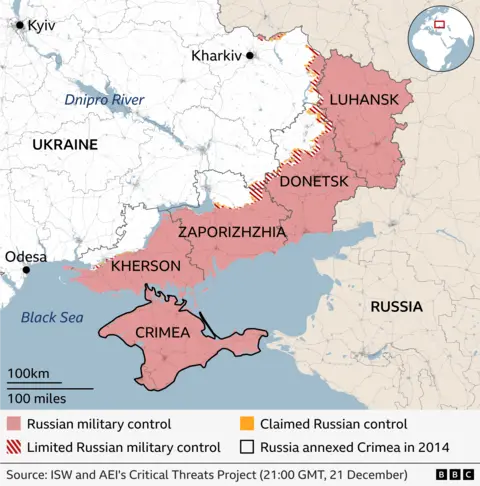
Ukrainian President Volodymyr Zelensky plans to meet former US President Donald Trump in Florida to advance a US‑brokered 20‑point peace plan and separate US security guarantees; Zelensky said the plan is roughly 90% complete and discussions include a US‑proposed demilitarised economic zone with potential reciprocal 40km pullbacks in Donbas. Kremlin envoys and US negotiators continue talks, but Moscow remains unlikely to accept key territorial proposals and still demands full control of parts of Donbas; the deal contours also address security guarantees modelled on NATO Article 5 and maintaining Ukraine’s military at ~800,000. Energy and infrastructure remain flashpoints: the Zaporizhzhia nuclear plant (under Russian control) and recent strikes on Kharkiv and refineries in Rostov/Krasnodar underscore ongoing combat risk, leaving geopolitical uncertainty that could influence energy and defense exposures.
Market structure: A negotiated pause or demilitarised zone reduces the immediate war premium (negative for defense names LMT/RTX/NOC and European gas exporters) but increases idiosyncratic winners — US security guarantors, reconstruction/materials (steel, construction) and select energy producers (XOM, CVX) if supply disruption persists. Expect a 5–15% swing range in Brent on week-to-week headlines; oil/gas and grain markets retain asymmetric upside while defense earnings sensitivity to ceasefire is concentrated in 1–3 quarters.
Risk assessment: Tail risks include breakdown of talks leading to rapid escalation (oil > $120/bbl, European gas 2x current nodal prices, sovereign risk in Eastern Europe) within days-to-weeks; conversely, a swift, credible deal in 7–30 days could compress defense multiples by 10–20% and drop oil 10–20%. Hidden dependencies: US domestic politics (Trump negotiating posture), leaks and control over Zaporizhzhia, and winter demand spikes that amplify supply shocks. Key catalysts: Sunday meeting outcome, public draft text, and congressional/European endorsement over next 2–6 weeks.
Trade implications: Near-term trade into volatility: overweight energy producers via XOM/CVX (3-month horizon) and tactical long fertilizers (MOS/CF) for grain-risk carry; pair trade short LMT vs long XOM to express peace-on headlines; use 60–120 day option structures to time event risk. Cross-asset: bid for USD/USTs on escalation; buy VIX call spreads as a <1% event hedge if headlines deteriorate sharply.
Contrarian angles: Consensus presumes peace = broad defense drawdown — missed is reconstruction-driven multi-year demand (infrastructure, specialty metals) and persistent base-level security spending that supports LMT/RTX earnings beyond 12 months. Historic parallels (Minsk 2014–15) show recurring flare-ups after diplomatic pauses: fade initial defense selloffs and layer trades on realized-volatility spikes. If peace terms leak favouring Russia, expect sanctions cycles that create idiosyncratic winners among Western weapons suppliers and commodity traders.
AI-powered research, real-time alerts, and portfolio analytics for institutional investors.
Request DemoOverall Sentiment
mildly negative
Sentiment Score
-0.25
