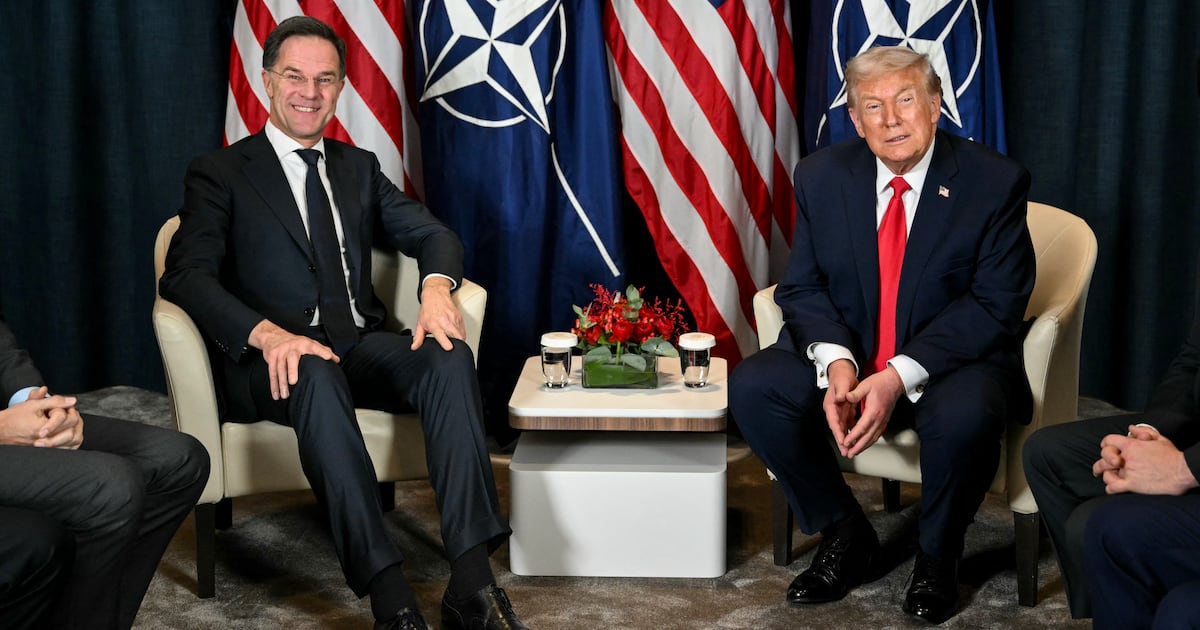
At the Davos summit NATO Secretary General Mark Rutte defused a potential U.S.–Europe confrontation after President Trump threatened to seize Greenland and levy tariffs on eight European allies, securing a compromise that leaves overall Greenland sovereignty with Denmark according to two Axios sources. Trump verbally characterized the arrangement as a "long-term" or "forever" deal, while Rutte’s intervention averted immediate tariff action and broader NATO rupture; the episode reduces a short-term geopolitical tail risk but underscores continued policy volatility from the U.S. presidency and potential implications for defense and trade policy planning.
Market structure: NATO de‑escalation removes an immediate tariff shock to European exporters but preserves a structural upside for defense and Arctic‑resource suppliers. If several European members move from ~2% to 5% of GDP on defense (a >2x increase for many), that implies incremental defense procurement demand on the order of tens of billions EUR/yr over 1–3 years, favoring large primes and specialized industrial suppliers while weighing on cyclical European exporters only if tariffs reappear.
Risk assessment: Tail risks include a sudden re‑escalation by the U.S. president (tariffs, sanctions) that could knock 3–7% off targeted EU export sectors in weeks; lower‑probability seizure of territory would be catastrophic geopolitically but remains unlikely. Immediate (days) markets should remain calm; short term (weeks–months) pricing will be driven by NATO communiqués and EU budget votes; long term (12–36 months) depends on procurement cycles, domestic offsets and Arctic permitting timelines.
Trade implications: Favored trades: long US defense primes (Lockheed LMT, Northrop NOC, RTX RTX) to capture procurement upside and supply‑chain re‑shoring; use modest sizing (1–2% per name) with 12–24 month horizon. Hedge/paired trades: long LMT vs short Airbus (EADSY) to isolate US defense rerating; buy 6–12 month call spreads on LMT or NOC to leverage upside while capping premium; allocate 0.5–1% to GLD or GDX as tail insurance against policy shocks.
Contrarian angles: Consensus underestimates procurement lead times and overestimates immediate revenue flow to primes — upside may be concentrated in mid‑tier suppliers and MRO specialists (e.g., GD, LMT subcontractors) over 12–36 months. Historical parallels (post‑Cold War rebuilds) show 18–36 month lag to revenue; monitor NATO budget votes, US executive actions, and Greenland mining permits (next 6–12 months) for conviction shifts.
AI-powered research, real-time alerts, and portfolio analytics for institutional investors.
Request DemoOverall Sentiment
neutral
Sentiment Score
0.00
