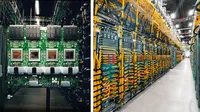
Google has launched Ironwood, its seventh-generation TPU optimized for high-volume, low-latency AI inference and model serving, delivering more than 4x performance per chip versus the prior generation and emphasizing energy efficiency. Ironwood scales to 9,216 chips in a superpod connected by a 9.6 Tb/s Inter‑Chip Interconnect with 1.77 PB of shared HBM, aiming to cut compute-hours and energy for training and inference; design improvements include AI-driven chip layout (AlphaChip) used by DeepMind. Availability to Cloud customers strengthens Google’s infrastructure advantage for inference workloads and could materially improve cost and performance dynamics for large-model deployments.
Market structure: Ironwood materially strengthens GOOGL's cloud differentiation — 4x chip improvement and ability to link 9,216 TPUs with 1.77PB HBM lowers per-inference $/sec and latency, favoring Google Cloud, enterprise AI vendors and Habana/vertical AI service resellers. Near-term losers: inference-dependent GPU demand (NVIDIA) and third-party inference accelerators; over 12–36 months this can exert pricing pressure on cloud GPU pricing and reduce incremental GPU TAM by an estimated 10–30% for inference workloads.
Risk assessment: Key tail risks are regulatory/antitrust action (US/EU investigations into vertical integration), export controls on advanced packaging/HBM, and yield/supply constraints for Ironwood and HBM. Immediate impact (days) is sentiment; short-term (3–12 months) is pilot customer wins and OEM orders; long-term (1–3 years) is measurable share shift in cloud inference and reduced customer GPU spend. Monitor HBM supply, superpod orders, and Cloud gross margin changes as triggers.
Trade implications: Core trade is pro-GOOGL exposure on 3–12 month horizon with tactical hedges against NVDA convexity. Consider small, defensive short exposure to GPU-reliant suppliers while rotating into cloud-native AI software and managed inference plays that benefit from lower infra cost. Options can express convexity: defined-risk call spreads on GOOGL around key earnings/CLOUD updates.
Contrarian angles: Consensus may overstate immediate displacement of NVIDIA for training — NVDA still entrenched for large-scale training and edge inference. The market could underprice Google’s integrated stack value (hardware+software+models) leading to persistent Cloud unit economics advantage; conversely, adoption lag, customer lock-in inertia, or HBM scarcity could delay benefits, creating mispricing opportunities over 6–24 months.
AI-powered research, real-time alerts, and portfolio analytics for institutional investors.
Request DemoOverall Sentiment
moderately positive
Sentiment Score
0.45
Ticker Sentiment
