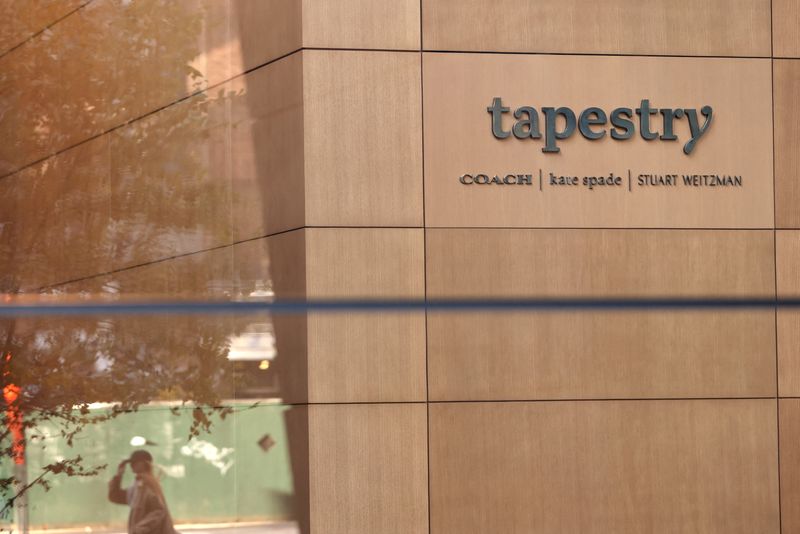
Tapestry delivered a sharp Q3 beat, earning $1.66 per share versus $1.28 expected on revenue of $1.92 billion, above the $1.76 billion consensus. The company raised full-year EPS guidance to about $6.95 from $6.40–$6.45, lifted revenue outlook to $7.95 billion from over $7.75 billion, and increased its adjusted free cash flow forecast to nearly $1.6 billion. It also plans about $1.3 billion of fiscal 2026 share repurchases, reinforcing a constructive earnings and capital return story.
The real signal here is not a one-quarter beat; it is that TPR is proving pricing power and cost leverage can coexist in a soft discretionary tape. That matters because luxury/aspirational consumer exposure has been discounting margin fragility, yet the company is expanding operating margin while increasing capital returns, implying demand is still elastic enough to absorb selective price/mix actions without a volume air pocket. In second-order terms, this reduces the odds of a broad de-rating across premium accessories and forces competitors to defend share with either promotion or heavier brand spend.
The stock’s next leg will likely come from estimate revisions rather than multiple expansion. If management is already pulling FY guidance materially higher, consensus for FY26 margin and FCF likely remains too low, which can support another 5-10% upward earnings reset over the next 2-3 quarters if sell-through holds. The key risk is that this is a beneficiary of category share capture rather than a clean demand inflection; if consumer trade-down weakens or promotional intensity rises into the next two seasonal windows, the margin narrative can compress quickly.
The buyback lift is underappreciated because it shifts the equity story from growth-only to a hybrid compounder with a clear floor under per-share earnings. However, that also creates a trap for momentum buyers: once the market prices in the guidance raise, the stock becomes more sensitive to any deceleration in revenue growth or gross margin normalization. The contrarian view is that consensus may be over-rotating this into a durable luxury upcycle when it may simply be a well-executed execution cycle with limited multiple durability if peers start matching the same playbook.
For portfolio construction, the best expression is relative value rather than outright chase. The upside is strongest if TPR continues to outperform while broader discretionary softens, but the trade should be sized with a catalyst horizon tied to the next two earnings prints and holiday sell-through data, not a multi-year thesis. If the company can hold these margins for another quarter, the market likely re-rates TPR as a capital-returning quality consumer name rather than a cyclical retailer.
AI-powered research, real-time alerts, and portfolio analytics for institutional investors.
Request DemoOverall Sentiment
strongly positive
Sentiment Score
0.82
Ticker Sentiment
