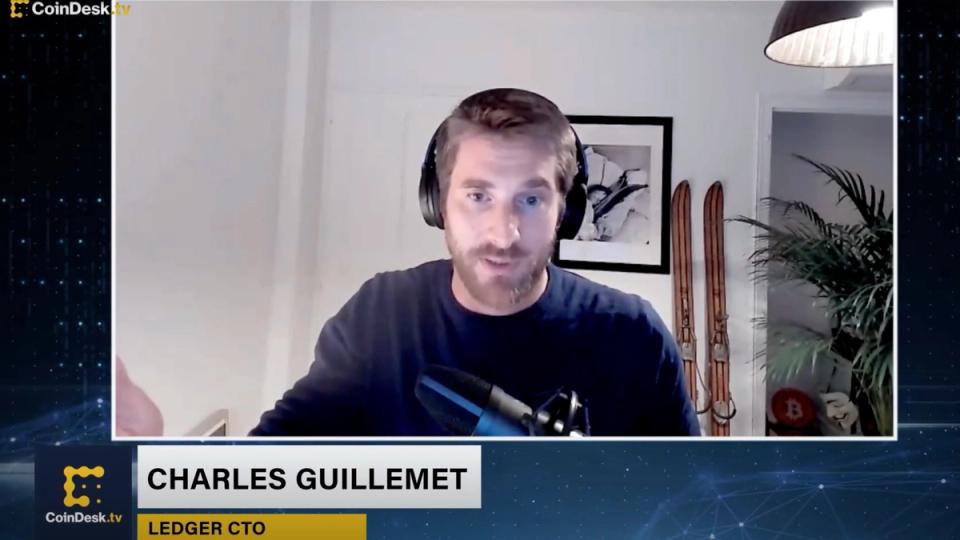
Key number: $1.4 billion in crypto losses over the past year, including a $285M Drift exploit and $25M Resolv loss. Ledger CTO Charles Guillemet warns AI is driving down the cost and time to find and exploit vulnerabilities, making hacks cheaper, faster and more widespread. He advises a shift to formal verification, hardware-based security and cold/offline storage; expect critical wallets and protocols to harden while much of the broader ecosystem remains exposed.
The arrival of generative AI is not just a step-function risk to code quality; it redefines where security value accrues. Over the next 6–24 months capital will migrate from unsecured protocol-native yields toward instruments and providers that can demonstrably remove private keys, introduce mathematical guarantees, or absorb replacement-cost losses — expect multiples expansion for vendors that can credibly claim formal verification, hardware isolation, or insurance wrappers.
Second-order supply-chain effects matter: firms that provide tooling (formal-verification libraries, secure firmware, HSM integrators) will face severe capacity constraints and pricing power, creating an M&A runway. Conversely, middleware and composable DeFi primitives that prioritize developer velocity over security will see funding and user bases shrink, increasing counterparty concentration risk for exchanges and custodians that remain exposed.
Near-term catalysts are binary and high-impact: a widely propagated AI-generated exploit or a mass-harvest malware campaign would accelerate asset flight to cold storage and spike insurance pricing inside days; regulatory guidance and industry certification programs could blunt the selling pressure over 12–36 months by creating minimum-security standards. The tactical implication is a multi-horizon playbook: defensive hedges for the next 3 months, selective reallocation into verified security suppliers over 6–18 months, and monitoring of certification/regulatory milestones as a trigger to scale exposure.
AI-powered research, real-time alerts, and portfolio analytics for institutional investors.
Overall Sentiment
strongly negative
Sentiment Score
-0.65
Ticker Sentiment
