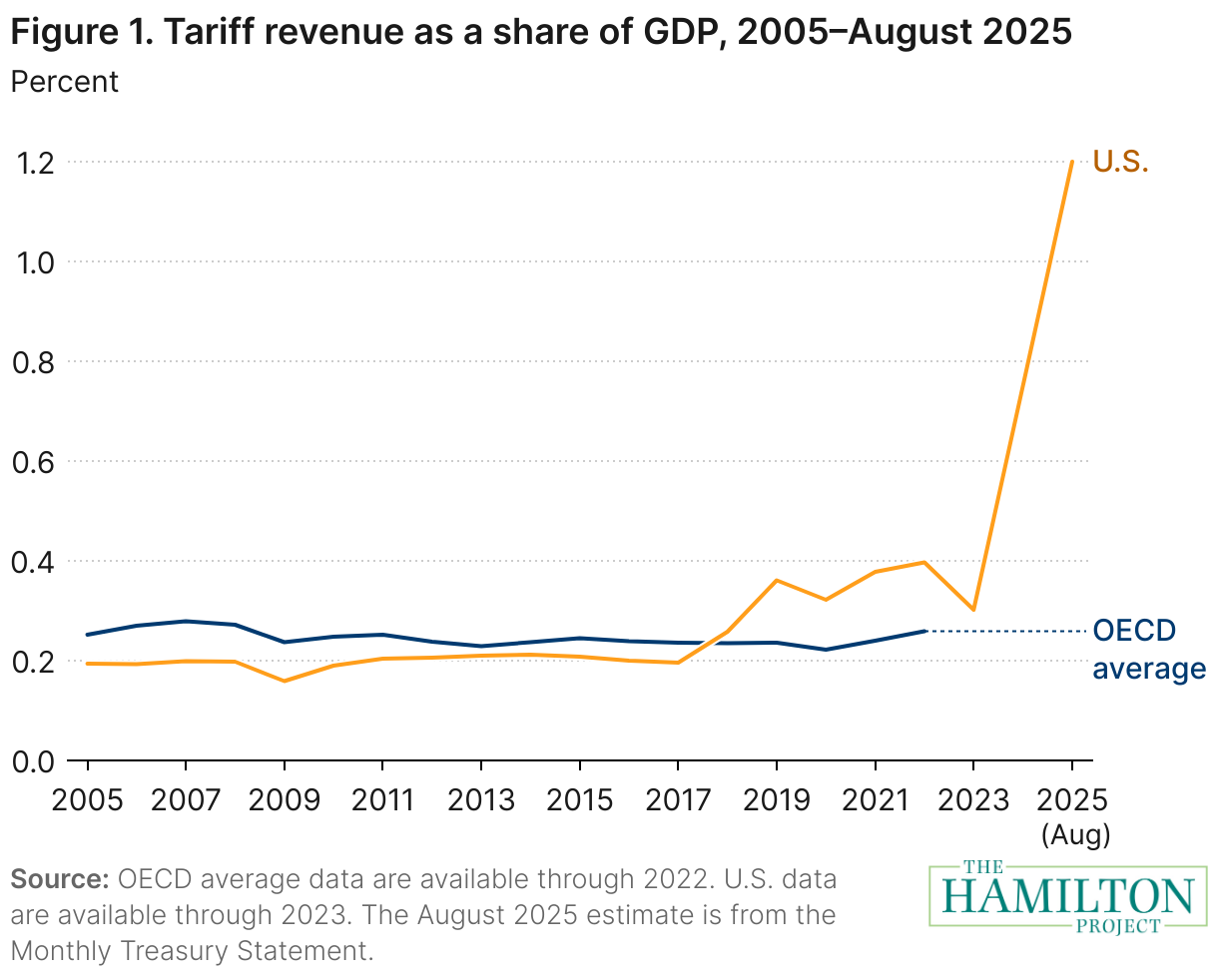
The article critiques the Trump administration's use of tariffs as a revenue-generating tool, asserting they are an inefficient and damaging economic policy despite the U.S. now collecting over 1% of GDP in tariff revenue, a level five times the OECD average and comparable to developing nations. It highlights that these tariffs, estimated to yield $30 billion in August 2025, reduce trade, increase costs for U.S. consumers and firms, and are projected to lower economic growth by 0.2 percentage points annually, potentially shrinking the economy by 1.5-2.5% over time. The analysis further notes tariffs are regressive, create business uncertainty, and harm international relations, with the costs ultimately borne by U.S. importers and consumers.
The Trump administration's tariff policies are generating significant revenue, with the U.S. collecting approximately $30 billion in August 2025, pushing tariff revenue to over 1% of GDP. This level is five times higher than the OECD average of 0.26% and comparable to less developed nations, marking a substantial shift from historical U.S. trade policy. However, the article critically views this as an inefficient and economically damaging approach to government funding.
These tariffs are projected to have a detrimental impact on U.S. economic growth, potentially reducing annual growth by 0.2 percentage points and shrinking the economy by 1.5% to 2.5% over time if trade declines by 10%. The White House OMB's estimate of a $4 trillion cost for a 1 percentage point lower growth over a decade suggests the current tariff regime could cost the government roughly $800 billion. This economic drag stems from increased costs for U.S. consumers and firms, reduced productivity, and hindered investment.
Beyond direct economic costs, the tariffs are identified as a regressive tax, disproportionately burdening lower-income households. The inherent uncertainty in tariff rates and exemptions discourages corporate investment, as evidenced by Ford's (F) reported reduction in U.S. investment due to rising input costs. Crucially, the analysis asserts that the costs of these tariffs are ultimately borne by U.S. importers and consumers, not foreign entities, further undermining their stated objectives and straining international relations.
AI-powered research, real-time alerts, and portfolio analytics for institutional investors.
Overall Sentiment
strongly negative
Sentiment Score
-0.80
Ticker Sentiment
