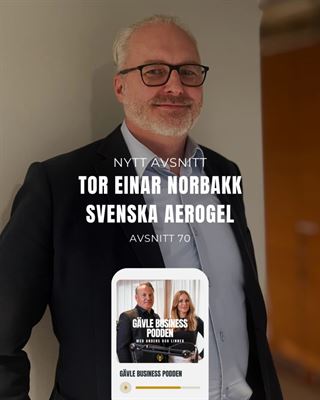
Svenska Aerogel CEO Tor Einar Norbakk discussed the company’s transition from a research organisation to a commercial, growth-focused business and its push toward global markets in a recent podcast appearance, highlighting its proprietary mesoporous material Quartzene® and management’s commitment to industrialisation and employees. The release reinforces strategic positioning around sustainable materials and commercialisation momentum but contains no financial metrics, guidance, or transaction news; therefore it signals positive management messaging rather than material market-moving information for investors.
Market structure: Svenska Aerogel’s move toward commercialization strengthens demand for high-performance insulation and specialty mesoporous materials, benefiting incumbent public peers (e.g., Aspen Aerogels, ASPN) and capex suppliers to industrial insulation markets. Winners: manufacturers of aerogels, OEMs in high-temp/EV battery thermal management, and green-building retrofit contractors; losers: commodity insulation producers (mineral wool, polyurethane) where cost-per-R-value advantages could erode over 12–36 months. Pricing power will be localized to early adopters with >10% performance lift; broad market share gains require cost reductions to <$50/kg or demonstrated lifecycle ROI within 3–5 years.
Risk assessment: Tail risks include failure to industrialize (capex overrun >20% vs plan), IP litigation, or feedstock shortages that could push unit cost +30% and delay revenue 12–24 months. Short-term (days–weeks) market reaction will be muted; medium-term (3–12 months) depends on announced pilots/order volumes; long-term (2–5 years) upside hinges on securing >=3 commercial OEM contracts or recurring revenue >€5–10m/year. Hidden dependencies: adoption tied to regulatory incentives (carbon pricing/retrofit subsidies) and commodity cycles for silica precursors.
Trade implications: Direct plays: long specialty-materials names (ASPN) and small exposure to materials ETF XLB to capture sector lift; use 6–12 month call spreads on ASPN to leverage commercialization news while capping cost. Pair trade: long ASPN vs short commodity insulation exposure (select industrial names with >50% revenue in mineral wool) to isolate technology premium. Entry: size initial exposure 0.5–2% of portfolio and scale on confirmation events (pilot orders, >€2–5m bookings within 6 months).
Contrarian angles: Consensus underestimates timing and scale risks—commercialization announcements rarely convert to mass adoption without price parity or policy tailwinds; current optimism may be underdone for First North small-caps where liquidity and execution risk are higher. Historical parallels: advanced-materials innovators often take 3–7 years to reach meaningful revenue (e.g., carbon fiber, graphene). Unintended consequence: rapid scaling could compress margins if feedstock shortages force spot purchases, turning a technology story into a working-capital drain.
AI-powered research, real-time alerts, and portfolio analytics for institutional investors.
Request DemoOverall Sentiment
mildly positive
Sentiment Score
0.30
