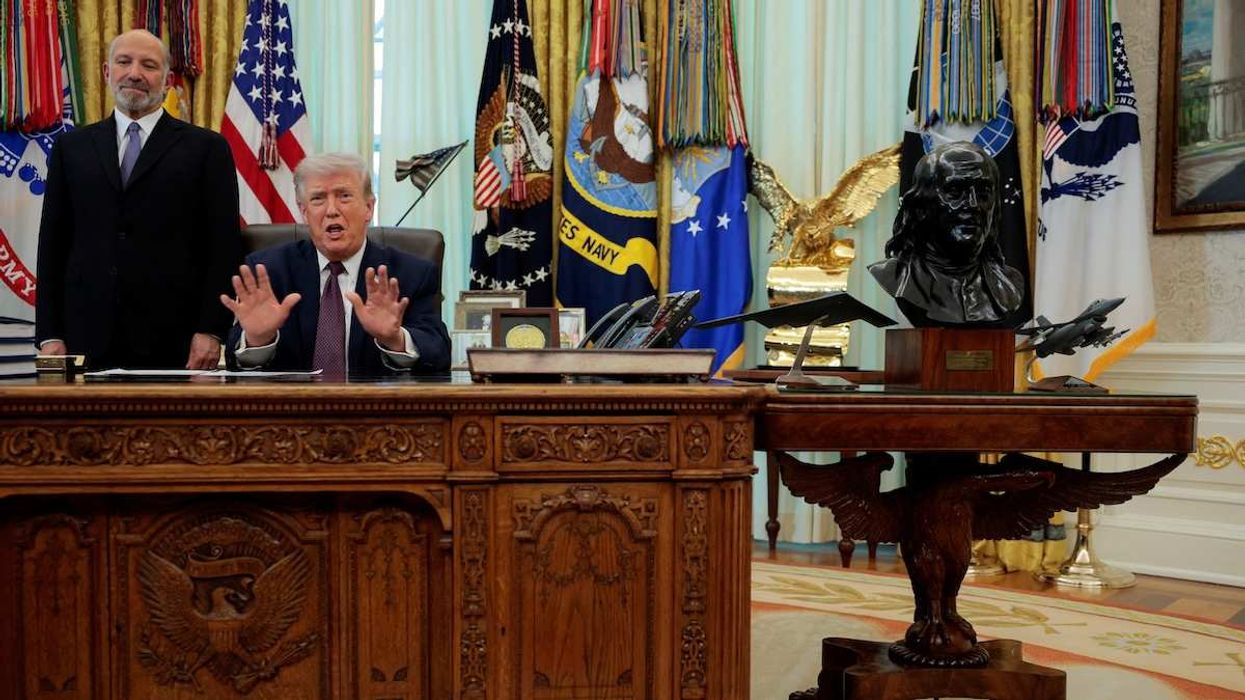
Key event: President Trump will address the nation at 9pm ET on Iran amid conflicting signals over escalation and control of the Strait of Hormuz; public opposition to the war is high as 87% of Americans say prices are at 'crisis' levels and average gasoline has topped $4.00/gal for the first time in three years. Space: NASA is launching Artemis II, the first crewed lunar mission since Apollo 17, with four astronauts (three U.S., one Canadian) set to orbit and return April 10; the U.S. and China have invested roughly $400bn in the space economy since 2009 and AI firms are exploring space-based data centers. Demographics: India begins a two-phase census of ~1.4bn people using in-person surveys and a first-time mobile app, deploying 3 million enumerators over a year and collecting caste data for the first time since independence, which could alter parliamentary/state seat allocations and welfare distribution.
The near-term political uncertainty centered on the presidential address creates a discrete volatility event that will most directly manifest in energy and defense risk premia; expect headline-driven crude moves of $3–12/bbl within 48–72 hours depending on language about force posture or sanctions, and a corollary 10–30% intraday skew lift in frontline defense names. Second-order effects: shipping insurance and physical logistics spreads will widen, pushing bunker and freight costs higher and pinching refining/chemical margins unevenly across regions — Gulf Coast refiners see different throughput economics than Northwest Europe if the Strait of Hormuz risk premium spikes.
Artemis II (and the broader push to operationalize space as an industrial zone) is a multiyear revenue opportunity for a narrow set of systems suppliers — power/thermal management, radiation-hardened semiconductors, and optical comms — that are oligopolistic and have >12–18 month backlog visibility. The AI-in-space thesis creates durable demand for specialized compute and cooling solutions; early movers can monetize via long lead government and commercial contracts, implying 20–40%+ revenue CAGR for select suppliers over 3 years if funding cycles continue.
India’s census will reallocate fiscal flows and political representation over 12–36 months; that redistribution is a structural positive for domestic banks, construction, telecom rollouts and targeted welfare suppliers but raises execution risk around localized social tensions. The contrarian angle: markets are pricing a sustained, high oil-for-longer shock; absent clear commitment to large-scale ground operations or extended Strait closures, a 4–8 week mean-reversion in energy and a re-compression of defense spreads is a plausible reversal scenario that makes defined-risk, short-dated option structures preferable to outright directional long-dated exposure.
AI-powered research, real-time alerts, and portfolio analytics for institutional investors.
Request DemoOverall Sentiment
mixed
Sentiment Score
-0.05
