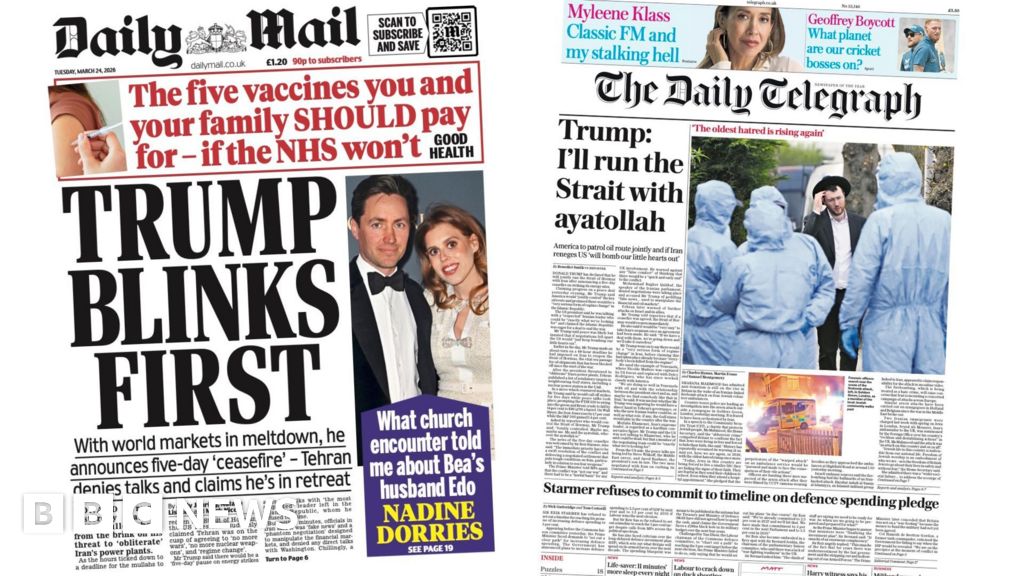
A US announcement of a five-day pause on strikes against Iran after reported talks prompted a rebound in stocks and bonds and a fall in oil prices; Tehran denies the US claims, leaving geopolitical risk elevated. Domestically in the UK, a high-profile arson attack on Jewish charity ambulances and a delayed UK–France migrant patrol agreement increase political and social tensions; monitor energy-price volatility and risk premia during the pause period.
Market moves priced to a headline-driven de‑escalation have likely compressed risk premia in energy and defense but left the physical and logistical tightness intact. The Straits and tanker insurance are binary upstream chokepoints — market-implied moves can reverse by 8–12% in Brent within 72 hours if transit risk resumes, so current lower implied vol is fragile.
Second-order winners from a sustained détente are highly cyclical: airlines, container lines and refiners see immediate margin relief via lower bunker and crude costs; freight and logistics companies benefit from narrower war-risk surcharges that currently sit as a >$3–6/bbl equivalent on transport. Conversely, defense primes and war-risk insurers carry headline-beta risk even though contract pipelines change slowly — that creates an asymmetric short opportunity if headlines calm but revenue visibility remains unchanged for quarters.
Key catalysts to watch in the coming days–weeks are (1) credible third‑party confirmation of any diplomatic terms (minutes to 2 weeks) and (2) any local Iranian operational steps in the Straits (hour–days) — both have outsized market impact. Tail risk is concentrated and binary: an operational blockade or missile strike on tankers would flip the oil/import cost narrative within days and reprice risk assets far more quickly than a negotiated rollback would normalize them.
Positioning should therefore be two‑pronged: harvest relief rallies in headline‑sensitive cyclicals while keeping low-cost, concentrated tail protection for the high‑impact Iran/Straits failure mode. Volatility sells look attractive only if financed by durable hedges that cap the ~5–12% oil shock scenario; otherwise headline noise will re-introduce jump risk.
AI-powered research, real-time alerts, and portfolio analytics for institutional investors.
Request DemoOverall Sentiment
mixed
Sentiment Score
0.00
