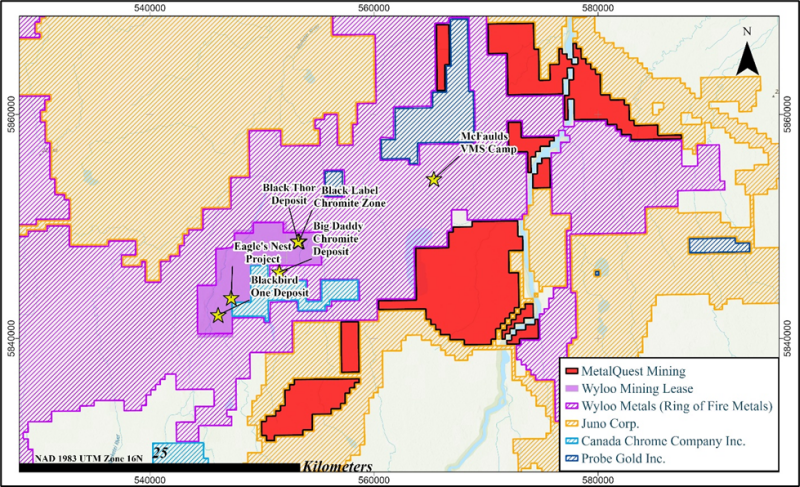
MetalQuest Mining (TSX.V: MQM) closed the first tranche of a non‑brokered private placement raising $946,780.20 via 5,259,890 flow‑through units at $0.18 and $686,160.80 via 4,036,240 non‑flow units at $0.17 (aggregate proceeds from the tranche $1,632,941; company reports ~US$2.15M raised as of Dec 30 with a second tranche expected in early Jan 2026). The company expanded its asset base with the ROF‑1 acquisition (1,034 claim cells, ~20,800 ha) in Ontario’s Ring of Fire, added the 100%‑owned Superior Iron Project in the Labrador Trough, and engaged AtkinsRéalis to perform a Gap Analysis on the Lac Otelnuk 2015 feasibility work (report due Jan 2026). Financing terms include warrants exercisable at $0.40 for two years, a four‑month plus one day hold expiring May 1, 2026, finder’s fees of $48,402.03 and 243,304 finder warrants; insiders participated in the financing under MI 61‑101 exemptions. Overall, the release signals near‑term technical catalysts and further funded exploration activity while preserving upside for current shareholders.
Market structure: MQM (TSX.V: MQM) and nearby Quebec/Ontario juniors are the direct beneficiaries of rising investor focus on high‑purity iron and Ring of Fire access; Canadian Copper (CCI) and service providers (AtkinsRéalis) also stand to gain near‑term fees and re‑rating. Incumbent seaborne low‑grade producers (VALE, RIO, MT) see limited near‑term revenue impact, but a successful Lac Otelnuk path to development could impose a 10–20% premium on high‑purity product pricing and shift niche steelmaking feed margins over 1–3 years.
Risk assessment: Key tail risks are Indigenous or permitting delays, failure of financing (dilution >25%), and a >25% iron‑price shock that collapses junior valuations; all are credible within 12–24 months. Immediate catalysts: Gap Analysis due by end‑Jan 2026, second placement tranche in early Jan 2026, and CCI’s Murray Brook PEA H1 2026; liquidity is constrained by a hold period to May 1, 2026, raising short‑term volatility.
Trade implications: Tactical size small and defined — treat MQM as a high‑conviction micro‑cap catalyst play: consider establishing a 2–3% portfolio long in MQM ahead of the Gap Analysis (enter by Jan 25, 2026), target +150–200% on positive Gap/partner signals, hard stop at −50% or rebalance if dilution risk rises >15%. Pair idea: long MQM (2%) vs short RIO (0.5% notional) to hedge iron‑price beta; hedge via buying 3‑month RIO put spread (e.g., 5%–10% OTM) sized 0.5–1% portfolio to protect against iron‑price downside.
Contrarian angles: The market underestimates timeline and permitting friction — consensus is pricing in fast JV/M&A (6–12 months) whereas realistic commercialization is 3–7 years; this understates financing/dilution risk. Conversely, upside may be underpriced if Gap Analysis confirms simple, low‑capex updates and triggers strategic interest — monitor Gap results and CCI PEA; if both are positive, re‑leverage to 4–6% but cap exposure given execution risk.
AI-powered research, real-time alerts, and portfolio analytics for institutional investors.
Request DemoOverall Sentiment
moderately positive
Sentiment Score
0.45
Ticker Sentiment
