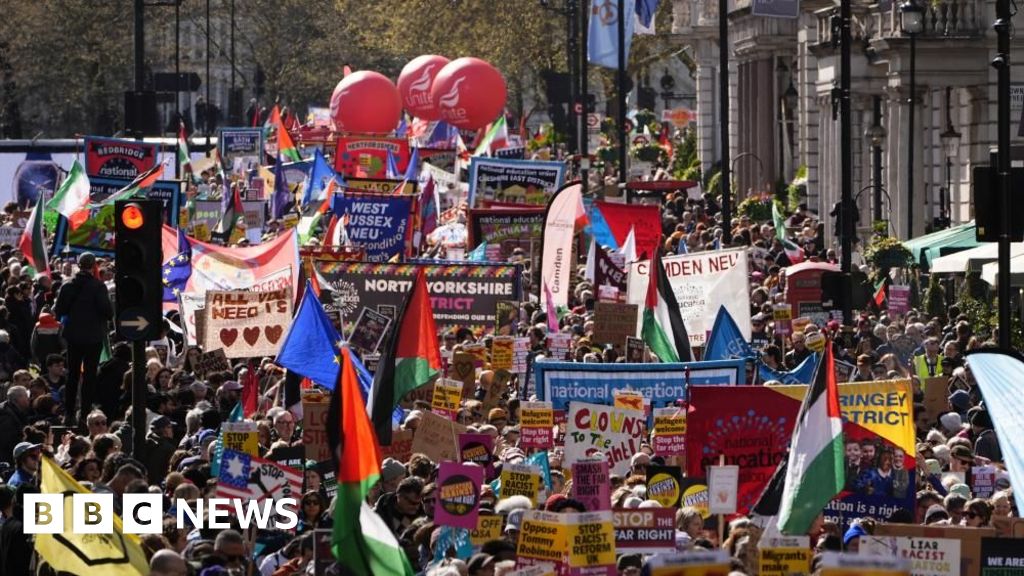
Organisers claimed up to 500,000 attendees at an anti–far-right march in central London while the Metropolitan Police estimated about 50,000, with crowds spread across the route. Police reported at least seven arrests linked to the main demonstration plus 18 separate arrests outside New Scotland Yard, and intervened to prevent breaches of the peace; high-profile figures and entertainers attended and speeches were planned at Whitehall.
Large public mobilisations that cut across unions, faith groups and grassroots organisers tend to have predictable follow-through: accelerated procurement cycles for public-order services, a pull-forward of spending on surveillance and crowd-management technology, and a non-linear rise in demand for private security and consultancy. These shifts are not month-long; contracting, tendering and deployment timelines mean visible revenue uplifts for contractors typically show up on P&Ls at the 3–12 month mark and crystallise into multi-year framework deals if governments choose to institutionalise new capabilities.
A second-order channel is labour and cost pressure in the security ecosystem. Rapid scaling of private security and event staffing usually forces higher hourly wages and short-term agency premiums; operators with scalable tech/software layers (reducing headcount per event) will outcompete pure manpower providers and thus capture margin expansion. Separately, media and platform firms face reputational and regulatory crosswinds: sustained politicised events raise the odds of tougher content rules and advertiser sensitivity, which compresses ad CPMs episodically and raises regulatory compliance costs over 6–24 months.
From a political-economy perspective, repeat mass mobilisation increases policy volatility and creates asymmetric tail-risk: a single violent escalation or high-profile breach can trigger emergency legislation, accelerated capital allocation to security and defense, and swifter rollout of surveillance procurement — outcomes that benefit defence-tech and event-security vendors but create headwinds for consumer-facing hospitality and mass-advertising revenue pools in the near term.
AI-powered research, real-time alerts, and portfolio analytics for institutional investors.
Request DemoOverall Sentiment
neutral
Sentiment Score
0.00
