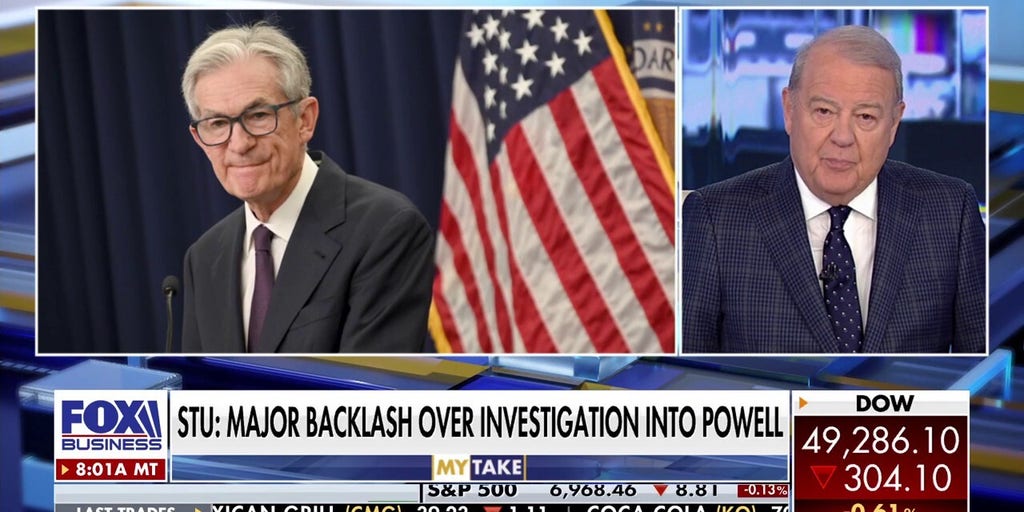
The content is a television programming schedule listing Fox Business and Fox News time slots and shows (including Kudlow, The Evening Edit with Elizabeth Macdonald, The Will Cain Show, and The Five). It contains no financial data, company metrics, policy announcements, or market analysis, and therefore presents no actionable information for investment decisions.
Market structure: The programming snippet signals stability in linear news viewership — incumbent broadcasters (Fox Corp, FOXA/FOXB; Nexstar, NXST) directly benefit from sticky political audiences that support higher ad CPMs and retransmission fees. Pure-play streamers and ad-supported digital platforms (WBD, DIS, NFLX, GOOG/FB exposure to video ad inventory) lose pricing power as advertisers concentrate dollars into politically targeted linear slots; expect CPM uplifts of 5–20% in election quarters. Cross-asset: modest positive for high-yielding media equities, neutral-to-negative for long-duration streaming cash-flow assets; rising political-driven volatility will lift short-dated options IV on media names and could tighten credit spreads for well-capitalized broadcasters.
Risk assessment: Tail risks include a sharp advertising recession (-10–20% ad spend), regulatory action on political ads or retransmission rules, or a reputational scandal that triggers c.20–30% sell-offs. Immediate (days) impact is noise; short-term (weeks–months) driven by monthly Nielsen ratings and ad bookings; long-term (years) dominated by cord-cutting and streaming monetization. Hidden dependency: retransmission fees and local affiliate deals constitute >20–40% of cash flows for broadcasters — disputes can cause outsized revenue swings. Key catalysts: monthly ratings, quarterly ad revenue prints, and any FCC/DOJ notices in the next 30–90 days.
Trade implications: Direct play — size a tactical 2–3% long position in FOXA (Nasdaq: FOXA) with a 3–6 month horizon to capture CPM tailwinds, target +8–12%, stop -7% on earnings/ad-miss. Pair trade — long FOXA vs short WBD (Nasdaq: WBD) 1.5:1 to isolate linear vs streaming ad-risk over 3–6 months. Options: buy a 3-month FOXA call spread (5–10% OTM) sized to 0.5–1% notional to cap premium while skewing to election-driven upside.
Contrarian angles: Consensus underestimates retransmission and local ad resilience — broadcasters can sustain margins longer than models assume; market may be underpricing 12–24 month free-cash-flow conversion for FOXA by 10–20%. Conversely, the market might be too sanguine on WBD/DIS cost cuts; if CPMs reallocate to linear, streaming churn and ad yield deterioration could fast-track write-downs. Unintended consequence: aggressive positioning into FOXA without hedging could suffer sharp drawdowns if an ad-booking miss (>3%) or regulatory headline occurs within 30 days.
AI-powered research, real-time alerts, and portfolio analytics for institutional investors.
Request DemoOverall Sentiment
neutral
Sentiment Score
0.00
