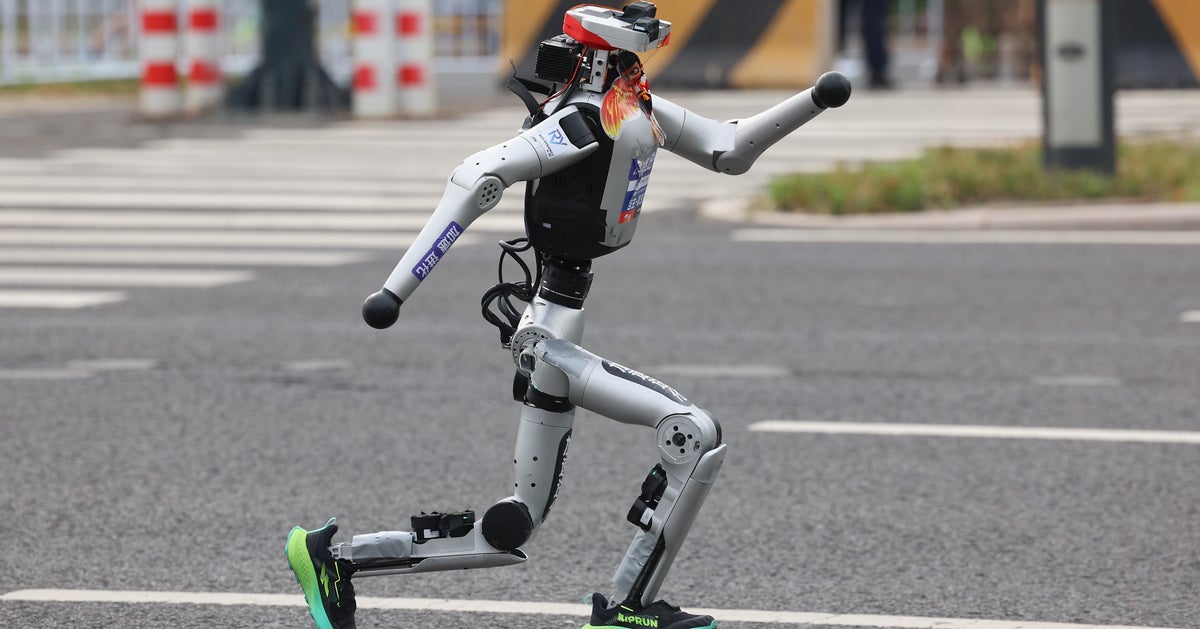
Chinese humanoid robots completed a Beijing half-marathon in 50 minutes and 26 seconds, with the winning Honor-developed robot and the top three finishers all posting world-record-beating times. Nearly half of robot entrants navigated autonomously, up from remote-controlled operation last year, signaling meaningful progress in robotics and AI. The article is broadly positive for China’s robotics sector, though it remains early-stage and not yet commercially proven.
This is less a “robotics breakthrough” than a signal that China is compressing the iteration cycle in electromechanical systems. The important second-order effect is not the race itself, but that endurance, balance, thermal management, and autonomy are now being validated in a public, standardized stress test—exactly the capabilities that lower warranty risk and move humanoids from demo units toward pilot deployments. That shifts the market from speculative “AI story” names to the picks-and-shovels stack: motors, harmonic drives, servos, batteries, thermal materials, machine vision, and industrial automation integration. The near-term beneficiaries are domestic Chinese component suppliers and systems integrators that can leverage policy-backed procurement and a national showcase effect. The losers are foreign incumbents selling “imported prestige” into China’s robotics budget; if local firms can demonstrate performance parity in front of consumers and policymakers, procurement preference will likely tilt harder toward domestic supply chains over the next 6-18 months. A subtler winner is smartphone-adjacent engineering IP: liquid cooling, lightweight materials, and battery management are becoming transferable assets into humanoids, which raises the strategic value of consumer-electronics design teams and accelerates convergence between handset and robotics platforms. The contrarian issue is commercialization velocity. Public athleticism does not solve the hardest bottleneck: dexterous manipulation in cluttered factory environments, where uptime, perception robustness, and service costs matter more than speed. The market may be overpricing a straight-line path from “impressive demo” to revenue inflection; the realistic monetization window is years, not quarters, unless there is a sudden breakthrough in manipulation software and actuator reliability. That means the biggest risk to bullish robotics equity trades is a sentiment air-pocket once investors realize the addressable market is pilot-heavy and capex-light in the near term. Catalyst-wise, watch for three things over the next 3-9 months: procurement orders from state-owned enterprises, robot-component export controls or subsidy changes, and evidence of factory trial conversions into repeat orders. If China starts mandating humanoid adoption in logistics or manufacturing pilots, the trade moves from narrative to earnings. Absent that, this remains a high-beta innovation signal best expressed through diversified enablers rather than single-name humanoid pure plays.
AI-powered research, real-time alerts, and portfolio analytics for institutional investors.
Request DemoOverall Sentiment
mildly positive
Sentiment Score
0.45
