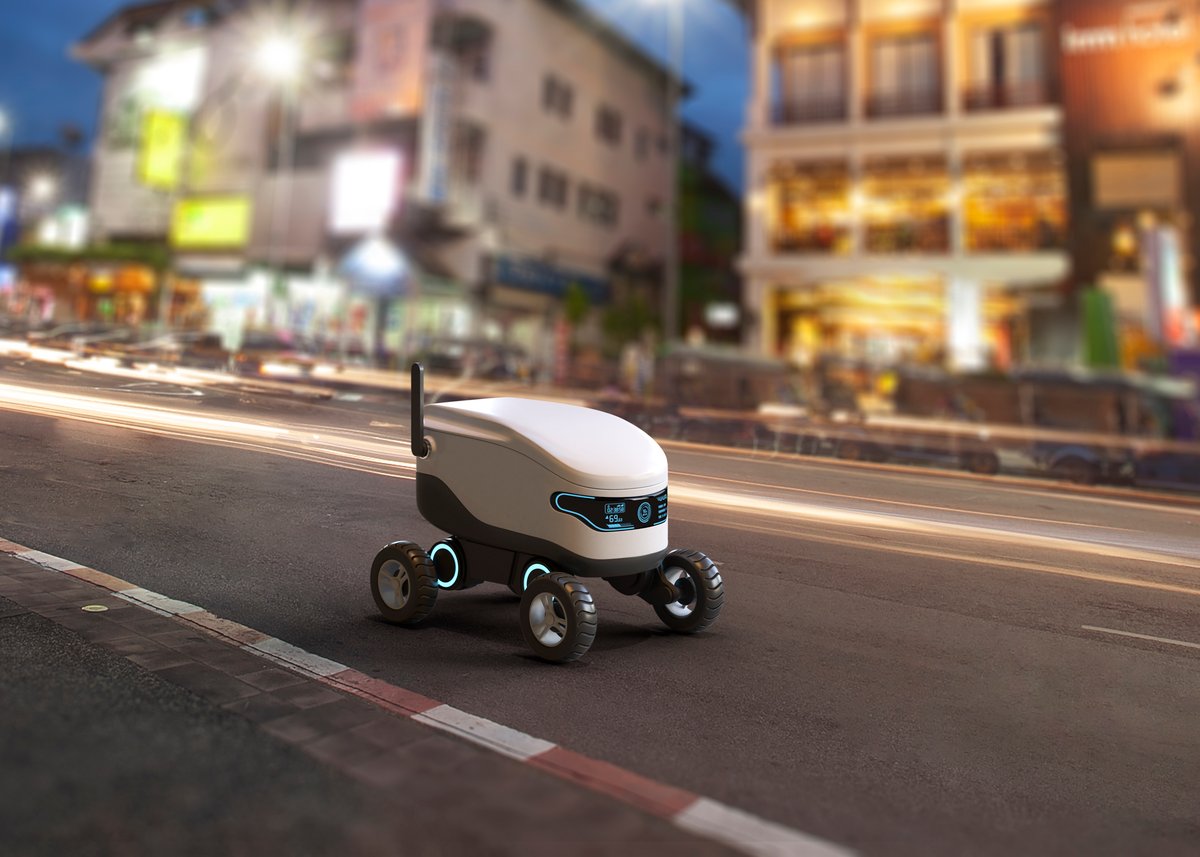
Serve Robotics, a roughly $670 million autonomous last‑mile robotics company in which Uber is a major shareholder, is scaling its Level‑4 Gen3 robots into Uber Eats with a target of 2,000 units deployed across major U.S. markets by end‑2025 and argues a $450 billion addressable market by 2030 if it can cut cost per delivery toward $1; the fleet has completed 100,000+ deliveries across 3,600 restaurants and Serve says each robot pays back in under a year at full utilization. Financially the company remains nascent and loss‑making—Q3 revenue was $687k versus $30.4m in operating costs and a GAAP loss of $33.2m (YTD net loss $67.1m up 157%)—but it held $210m liquidity at quarter end and raised $100m in October, and management forecasts revenue of $2.5m in 2025 ramping to ~$25m in 2026 once robots are fully integrated. Wall Street is broadly bullish (6 buys, 1 hold; average target $18.50, Street high $26), yet the stock trades at a frothy 245x P/S, leaving large upside contingent on flawless execution and exposing investors to meaningful downside should deployment, unit economics or scaling costs disappoint.
Serve Robotics is a roughly $650–670 million autonomous last-mile logistics company in which Uber is a major shareholder; it spun out of Uber’s robotics effort after the Postmates acquisition and has completed 100,000+ deliveries for 3,600 restaurants with its Level 4 Gen3 robot. Management targets a 2,000-robot deployment into Uber Eats by end-2025 across major U.S. markets and projects a $450 billion addressable market by 2030, arguing unit economics could fall to ~$1 per delivery with each robot paying for itself in under a year at full utilization.
The company’s current financial position is early-stage and loss-making: Q3 revenue was $687,000 versus $30.4 million in operating costs (R&D $13.4 million) and a GAAP loss of $33.2 million; year-to-date net loss is $67.1 million (up 157%). Serve reported $210 million liquidity at quarter-end and raised an additional $100 million in October, while management forecasts $2.5 million revenue in 2025 rising to ~$25 million in 2026 if the 2,000-robot deployment achieves run-rate assumptions.
Analyst coverage is predominantly positive (six buys, one hold) with an average price target of $18.50 and a Street-high $26, implying 113%–200% upside, yet the stock trades at a frothy 245x P/S—about ten times the P/S of an established AI leader like Nvidia—creating high sensitivity to execution. The principal investment catalysts are successful Gen3 rollouts and verifiable unit economics; any shortfall on deployment, uptime, or costs could trigger a sharp valuation rerating given the thin revenue base and steep losses.
AI-powered research, real-time alerts, and portfolio analytics for institutional investors.
Request DemoOverall Sentiment
mixed
Sentiment Score
0.00
Ticker Sentiment
