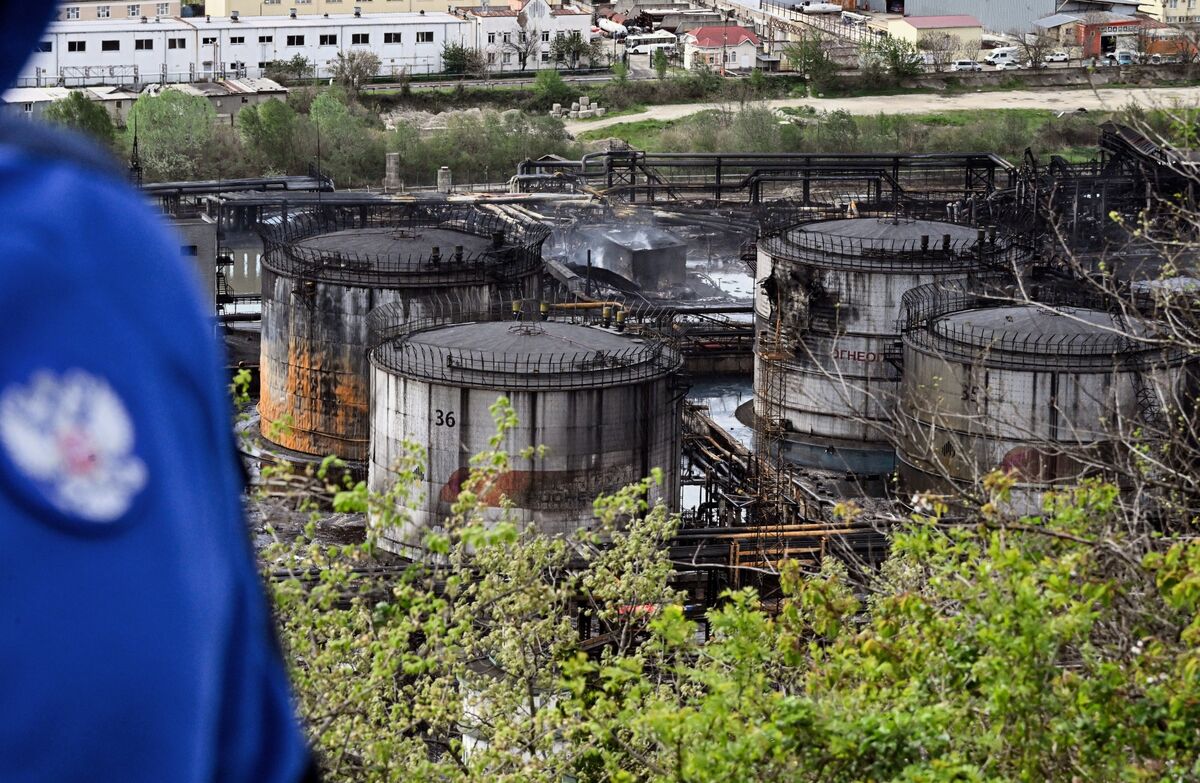
Russia expects 2026 oil output to stay flat at about 511 million tons of crude oil and condensate, or roughly 10.26 million barrels a day, before rising modestly to 516 million tons in 2027 and 525 million tons in the following two years. The outlook comes as Ukraine intensifies drone strikes on Russia’s energy infrastructure, creating operational risk for producers. The report is mildly negative for Russian energy supply expectations but largely factual in tone.
The important signal here is not just flatter Russian supply, but the growing optionality premium being embedded into the physical oil market. Repeated strikes on energy infrastructure tend to create a lagged effect: the first-order hit is operational downtime, while the second-order hit is higher insurance, logistics friction, and precautionary throttling that can keep barrels stranded even after repairs. That matters because a modest headline output path can still coexist with tighter export availability if inland flows, loading terminals, or power systems become the bottleneck.
Near term, this is more supportive for prompt crude than for deferred contracts: disruptions from sabotage typically lift backwardation before they alter full-year supply balances. Refined products can outperform crude if attacks impair upgrading or transport more than upstream production, especially in diesel where military and industrial demand is relatively inelastic. The biggest beneficiary outside the obvious energy complex is any non-Russian export path with spare capacity, as buyers pay up for reliability and shorter delivery chains.
The market may be underestimating the asymmetry of escalation. If Ukraine demonstrates it can reliably degrade throughput faster than Russia can harden infrastructure, the marginal impact on exports could accelerate nonlinearly over a 3-6 month window, not just a calendar-year basis. Conversely, if Moscow reroutes flows or adds redundancy, the price effect could fade quickly; the key catalyst to watch is not production guidance but realized export volumes, product cracks, and tanker loading delays over the next several weeks.
Consensus likely treats this as a modest supply-risk headline, but the more interesting trade is that it raises the probability of a persistent risk premium without requiring a large outright production loss. That premium is often too small at first, then reprices sharply after one or two visible outages. In that setting, owning upside convexity is preferable to linear longs if you believe the strike campaign is becoming more effective.
AI-powered research, real-time alerts, and portfolio analytics for institutional investors.
Request DemoOverall Sentiment
mildly negative
Sentiment Score
-0.15
