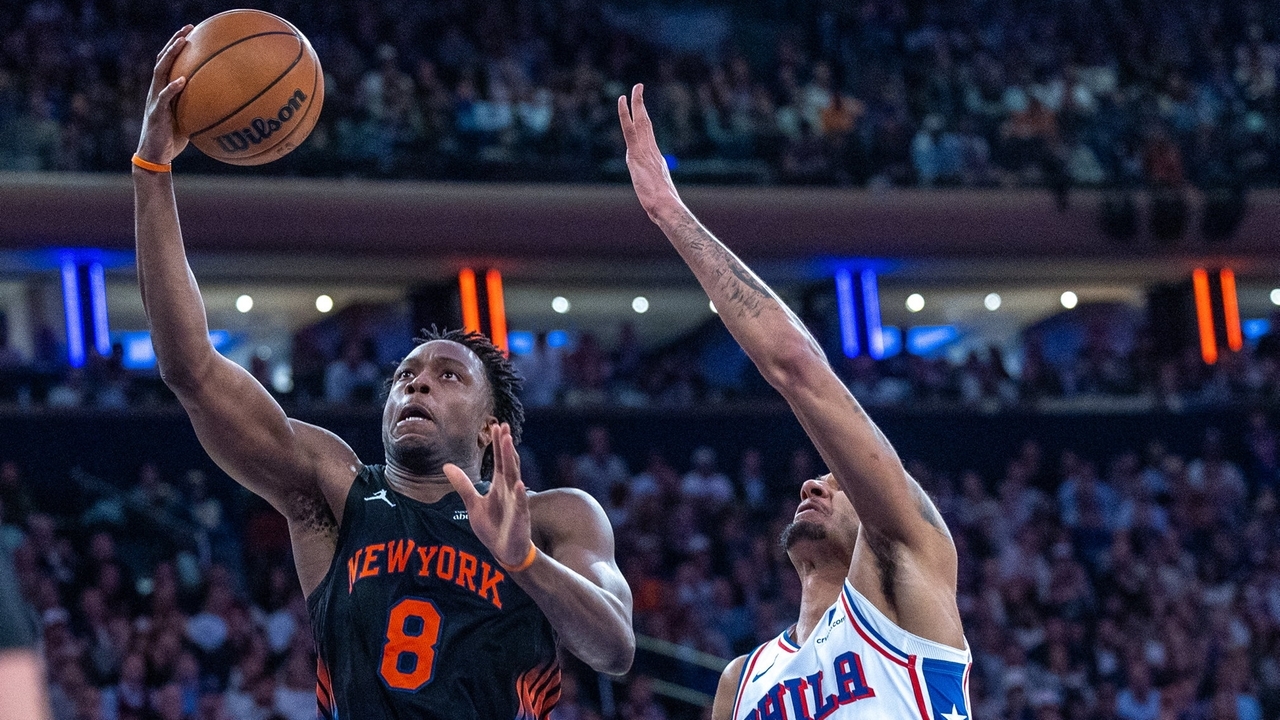
The Knicks won Game 2 108-102 and took a 2-0 lead in the Eastern Conference semifinals, but OG Anunoby exited in the fourth quarter with a right leg injury after scoring 24 points on 9-for-17 shooting. His status is unclear, and the team said only that he left the game; coach Mike Brown had no update after the win. The injury is a meaningful near-term headwind because Anunoby has been one of New York’s top two-way players in the playoffs.
The market should treat this less as a one-game injury headline and more as a distribution shift in the Knicks’ playoff odds. Anunoby is the team's only true matchup-neutral defender who can also scale offensively without usage leakage; if he’s compromised even for a week, the Knicks lose the one player who lets them survive the high-leverage minutes against star wings without overloading the rest of the rotation. That typically shows up first in the fourth quarter of close games: lower turnover pressure for the opponent, worse corner-3 quality on offense, and a narrower margin for foul trouble elsewhere.
The second-order effect is on roster elasticity. If Anunoby misses time, the Knicks likely need to lean harder on smaller lineups and heavier minutes for Bridges/McBride, which can preserve possession quality but also raises variance through shot-making dependence. That increases the probability of a slower, more grindy series rather than another blowout profile, which matters because a team with a thin creation base is more exposed to any single injury than the market tends to price in after a 2-0 lead.
The contrarian angle is that the immediate downside may be overstated if the injury is a short-lived cramp/strain rather than a structural hamstring issue. The key tradeable variable over the next 24-72 hours is not the game result but the injury classification and whether he’s limited in lateral movement; that determines whether this is a one-game volatility spike or a multi-game performance tax. If the report stays vague and the price reaction is large, that’s usually the time to fade the overreaction rather than chase it.
From a positioning standpoint, this is mainly a sentiment/event-volatility setup, not a fundamental story. The cleanest expression is via the team’s media/equity exposure through Madison Square Garden-related sentiment rather than a direct single-name catalyst, but the more practical trade is around playoff-game volatility if a market exists. The right horizon is days, not months: the downside is concentrated into the next injury update and next game rotation, while a quick return should snap expectations back fast.
AI-powered research, real-time alerts, and portfolio analytics for institutional investors.
Request DemoOverall Sentiment
mildly negative
Sentiment Score
-0.15
