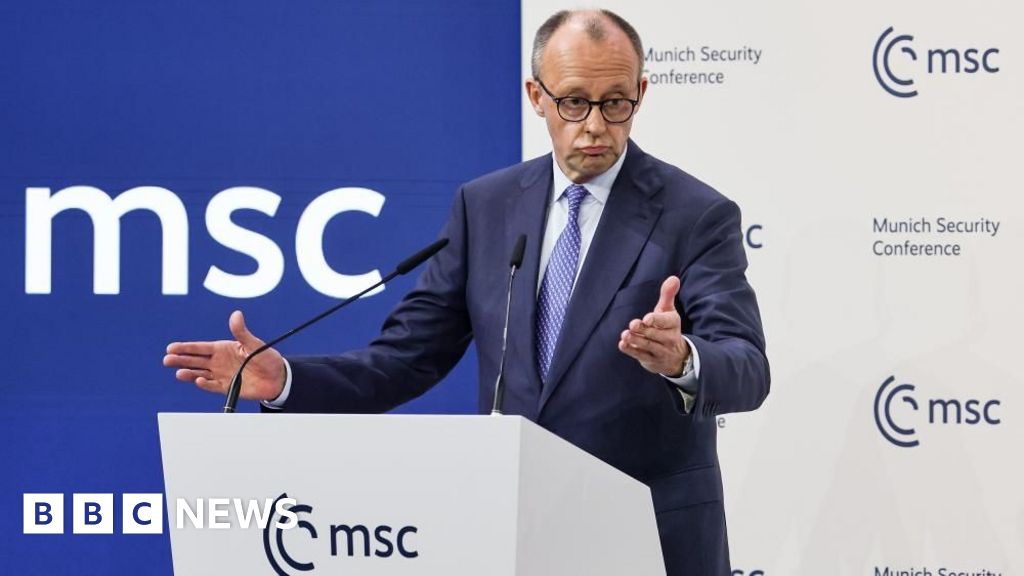
At the Munich Security Conference German Chancellor Friedrich Merz warned the rules-based world order "no longer exists," highlighted a deep rift with the United States and urged Europeans to prepare to make "sacrifice," while revealing confidential talks with President Macron on a joint European nuclear deterrent. Coupled with US President Trump’s threats over Greenland and tariff rhetoric, and ongoing Russia-Ukraine and China tensions, the remarks signal rising geopolitical risk that could boost defense spending, strain transatlantic cooperation and create headwinds for cross-border trade and investor confidence.
Market structure: The immediate winners are defence primes and suppliers to government programmes — US names (LMT, NOC) and European contractors (RHM.DE, BAES.L) gain procurement tailwinds as EU states accelerate re-armament; pricing power for scarce munitions, avionics and secure comms could lift sector EBITDA by 200–500bps over 12–24 months. Losers are trade-sensitive European exporters (auto parts, premium autos: VOW3.DE, BMW.DE) and low-margin manufacturing with long supply chains if tariffs/reciprocal measures increase; expect wider FX pass-through and margin compression of ~100–300bps in stressed tariff scenarios.
Risk assessment: Near term (days–weeks) expect safe-haven flows into USD, USTs and gold, and volatility spikes in FX and defence-equity options; medium-term (3–12 months) political catalysts (NATO meetings, EU budget votes, French-German declarations) will decide procurement funding and capex cadence. Tail risks include a substantive US-Europe trade showdown or accelerated Russian escalation — both could knock global GDP ~0.3–1.0% and spike energy prices; hidden dependencies are procurement lead times, semiconductor/rare-earth constraints and export-control regimes that can delay revenue realization by 6–18 months.
Trade implications: Favor tactical longs in defense via LMT/NOC (US) and a selective long in Rheinmetall (RHM.DE) for European upside; hedge macro tail risk with 1–2% GLD allocation and buy 3–6 month puts on Germany ETFs (EWG) sized to cover cyclical exposure. Use relative-value pair trades (long ITA or LMT vs short VOW3.DE/BMW.DE) to capture divergence between defence re-rating and industrial stress; consider 3–6 month call spreads on ITA or LMT to limit premium outlay while capturing upside from policy announcements.
Contrarian view: Consensus focuses on immediate US unpredictability; markets likely underprice the multi-year structural shift if Europe pursues strategic autonomy — past analogue: post‑2014 Ukraine defence repricing produced 30–60% outperformance for primes over 3 years. Beware that higher inflation and sustained rates are an unintended consequence (compressing multiples) — size positions conservatively, prefer pairs and option-backed exposure to avoid long-duration equity risk.
AI-powered research, real-time alerts, and portfolio analytics for institutional investors.
Request DemoOverall Sentiment
moderately negative
Sentiment Score
-0.45
