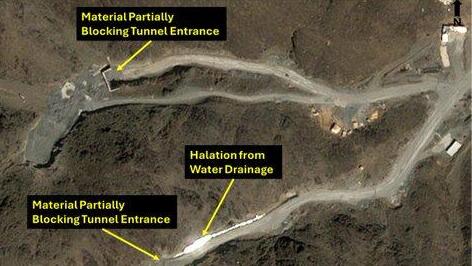
Satellite images show the two eastern tunnel entrances at Iran’s Mount Pickaxe underground complex were blocked with special soil by as early as April 22, whereas they were open on April 1. The material appears designed to impede vehicle access and would require heavy earthmoving equipment to clear, raising questions about activity at a deep underground facility south of Natanz. The development adds to geopolitical and nuclear-security concerns, but the direct market impact is likely limited unless it escalates into broader regional tension.
The market implication is less about the visible earthmoving and more about what it signals operationally: a shift from passive concealment to active hardening of a sensitive underground asset. That usually precedes a higher probability of either material relocation, pre-emptive dispersal, or a decision to make a site more resilient against strikes and inspections. In practice, the first-order asset is not the mountain itself but the scarce time window before outside actors can infer what is being protected and adjust policy or targeting.
The second-order effect is a likely increase in uncertainty premium across the entire Iran-exposure complex: crude, regional defense, cyber, and sanctions-enforcement beneficiaries. Even without kinetic escalation, this kind of imagery often tightens the policy clock by weeks to months, because it strengthens arguments for more intrusive monitoring, interdiction, or sanctions enforcement. That is bullish for defense primes and select intelligence/satellite-data providers, while being mildly bearish for European industrials and Asian refiners if the market starts pricing a higher probability of supply disruption or shipping risk.
The contrarian read is that visible blocking can also be decoy behavior designed to telegraph concern while the real move happens elsewhere. If so, the immediate market reaction in oil and defense could fade quickly unless corroborated by follow-on imagery, IAEA language, or government signaling. The setup is therefore better traded as a volatility event than a straight directional macro bet: the asymmetry lies in being long convexity into the next confirmation cycle rather than chasing the first headline.
AI-powered research, real-time alerts, and portfolio analytics for institutional investors.
Request DemoOverall Sentiment
moderately negative
Sentiment Score
-0.20
