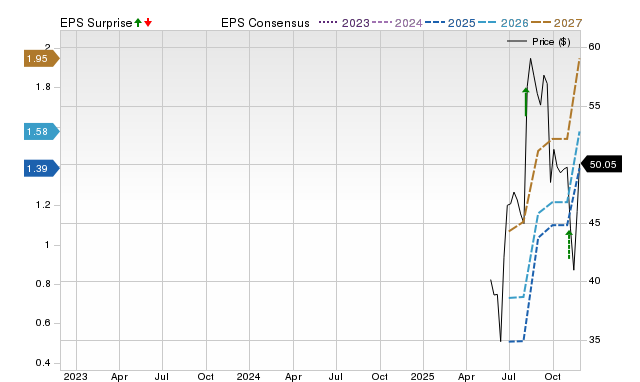
Hinge Health (HNGE) closed at $50.05 with a mean Wall Street price target of $64.86, implying roughly 29.6% upside; analyst targets span $56 to $72 with a standard deviation of $4.66. Zacks data shows seven upward revisions and no downgrades in the past month, lifting the Zacks Consensus Estimate for the year by 4.6% and supporting a Zacks Rank #2 (Buy). While the piece notes potential bias in price targets, the clustered analyst estimates and recent EPS estimate upgrades suggest growing near-term bullishness that could influence investor positioning in this digital-health name.
Market structure: A stronger-than-expected EPS revision cycle for HNGE benefits Hinge Health (HNGE), large self-insured employers (lower MSK spend) and outcome-focused digital therapeutics vendors; it hurts commoditized outpatient PT clinics and legacy physical-therapy chains as employers shift to PMPM virtual MSK care. If Hinge converts enterprise contracts at >10% price uplift vs incumbent spend it gains pricing power; failure to prove outcomes would reverse share gains. Cross-asset: a sustained rally would tighten credit spreads for private digital-health peers and raise implied vol in HNGE options by +30–50 bps around earnings; FX/commodity impacts negligible.
Risk assessment: Tail risks include adverse CMS/Medicaid reimbursement decisions or a negative large-scale outcomes study that could cause a 30–50% drawdown; a capital-raise at a lower valuation could dilute 10–25% equity value. Immediate (days) moves will track analyst revisions and headline wins; short-term (1–3 months) hinges on quarterly metrics (CAC payback, retention); long-term (≥12 months) depends on sustained PMPM pricing and churn <10%. Hidden dependency: enterprise renewals and integration with benefits platforms; loss of one marquee client could cascade.
Trade implications: Favor asymmetric, event-driven exposure. Size a tactical long (2–3% portfolio) funded by reducing generic telehealth exposure; use 3–6 month call spreads (buy 55 / sell 70, expiration Feb–May 2026) sized to cap cost at ~0.5% portfolio. Consider a relative-value pair: long HNGE vs short TDOC (equal dollar, 1.5% long / 1.5% short) to isolate MSK-specific outperformance. Use stop-loss at -18% and trim half of exposure if consensus EPS drops >3% MoM.
Contrarian angles: Analysts may underestimate margin lift from SaaS/COGS leverage — if retention and PMPM pricing improve by +5–10% next two quarters, EBIT margins could expand materially and justify >$70 target. Conversely, consensus may be too sanguine on sales efficiency; the market could be underpricing a 20–30% dilution risk if HNGE needs capital. Historical parallels: specialized digital winners (e.g., Livongo pre-merger) outperformed broad telehealth; but Peloton-style hardware/service mismatches warn against extrapolating subscription growth without churn proof.
AI-powered research, real-time alerts, and portfolio analytics for institutional investors.
Request DemoOverall Sentiment
moderately positive
Sentiment Score
0.35
Ticker Sentiment
