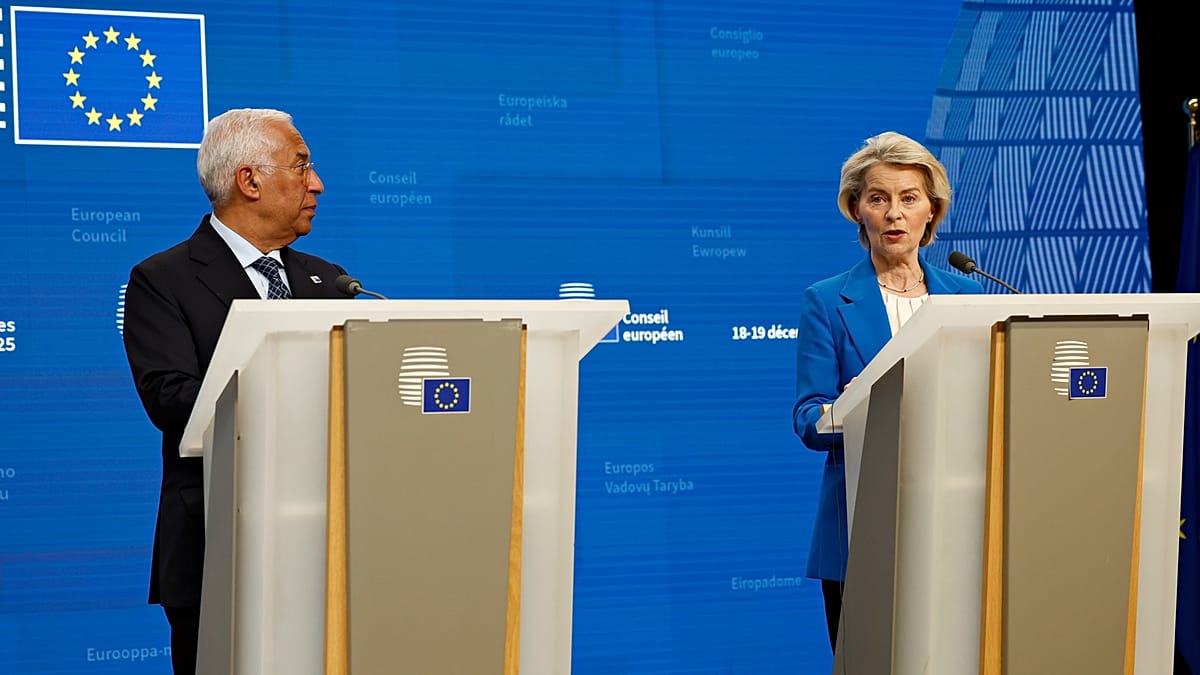
EU leaders agreed to raise €90 billion in joint debt to fund Ukraine over the next two years after failing to agree a novel reparations loan backed by immobilised Russian assets, with Hungary, the Czech Republic and Slovakia exempted from liability via an enhanced cooperation opt-out. Belgian demands for uncapped guarantees around Euroclear-held Russian assets blocked the reparations scheme, leaving the Commission to lend to Kyiv interest-free while the EU borrows in markets and pays interest—a structure that increases EU bond supply and political risk and leaves the prospect of Russia actually paying reparations doubtful. The move secures near-term funding for Ukraine but creates uncertainty over future liability, potential securitisation of Russian assets, and implications for EU budget exposure and sovereign/corporate bond markets.
Market structure: The switch from a reparations loan to €90bn of joint EU issuance increases sovereign-supply and political fragmentation risk (three-member opt-out). Expect issuance to depress core and peripheral bond prices; German 10y Bunds and French OATs face higher supply-driven yields in the 3–9 month window while the Euro area fiscal backstop mechanically benefits short-term funding markets and primary dealers that absorb paper.
Risk assessment: Key tail risks include (1) a legal/asset-seizure shock if Euroclear/Russian-asset litigation escalates, (2) an acceleration of political splits (Hungary/others) that creates persistent sovereign-premium dispersion, and (3) reputational loss that forces the loan to convert to grants increasing fiscal burden. Near term (days–weeks) expect headline-driven volatility; medium term (3–12 months) credit spreads and EUR funding curves will reprice; long term (1–3 years) defence and reconstruction demand should lift defence capex and commodity intensity.
Trade implications: Higher supply and political fragmentation favor short core rates (Bund futures FGBL), wider peripheral CDS, and modest EUR weakness vs USD; defensives and European defence primes (Airbus AIR.PA, Rheinmetall RHM.DE) are convex to increased military/reconstruction budgets. Buy protection via iTraxx Main 5y or buy selective peripheral sovereign CDS if spreads breach +30bp from current levels; use options to express EUR downside with puts concentrated at 1–3 month maturities.
Contrarian angles: Markets may underprice the chance reparations-securitisation returns as litigation/technical fixes — if a legal workaround emerges, EUR and core bonds would rally sharply; conversely, current pricing likely underestimates sustained political fragmentation that would permanently raise EMU funding premia by 10–40bp. Historical parallels: EU joint issuance (NextGen) tightened yields after successful deployment, but here political opt-outs make the path asymmetric — skew favors tactical shorts with defined stop-losses.
AI-powered research, real-time alerts, and portfolio analytics for institutional investors.
Request DemoOverall Sentiment
mixed
Sentiment Score
-0.05
