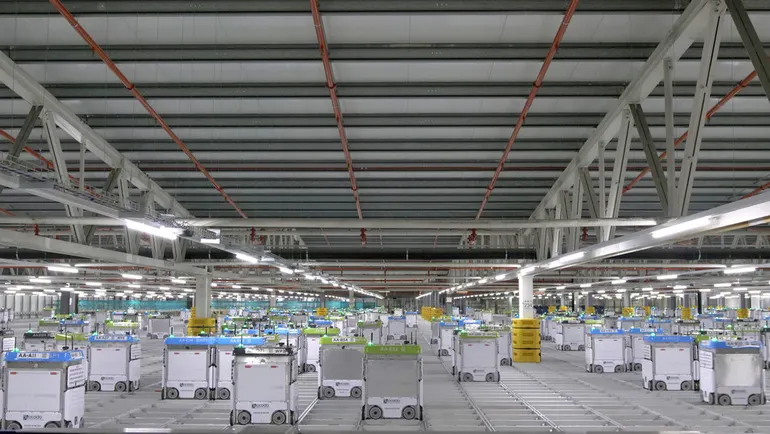
Kroger said it will target roughly $400 million of improved e-commerce profitability in 2026 by closing three automated Customer Fulfillment Centers (Pleasant Prairie, WI; Frederick, MD; Groveland, FL) in January and shifting toward in-store, capital-light automation and expanded third-party delivery partnerships, and will take about $2.6 billion of impairment and related charges in fiscal Q3 tied to the move. The company — which developed its automated network with Ocado and paused new rollouts last year — will continue to use CFCs in high-density markets while piloting store-based fulfillment, and has named Instacart its primary delivery provider (including an AI shopping pilot) while expanding DoorDash and upcoming Uber tie-ups. Despite five consecutive quarters of double-digit e-commerce growth (e-commerce sales were up 16% in Q2), Kroger’s online business remains unprofitable, and management says these actions are intended to deliver faster service and profitable digital sales growth.
Kroger announced a plan to improve e-commerce profitability by approximately $400 million in 2026 by closing three automated Customer Fulfillment Centers (Pleasant Prairie, WI; Frederick, MD; Groveland, FL) in January and shifting to greater in-store fulfillment and third-party partnerships; the company said it will record $2.6 billion of impairment and related charges in fiscal Q3 tied to these actions. The closures follow a company-wide “site-by-site” review of its automated network developed with Ocado, which paused rollouts in 2023 even as Ocado still plans two Kroger CFCs for fiscal 2026 in Charlotte and Phoenix.
Kroger’s e-commerce sales grew 16% in Q2 and the company cites five consecutive quarters of double‑digit e-commerce growth, but management and interim CEO Ron Sargent acknowledge the channel remains unprofitable and requires restructuring. The strategic pivot emphasizes capital‑light, store‑based automation pilots and deeper delivery relationships — Instacart is now the primary delivery provider and will pilot AI basket-building in Kroger’s app, DoorDash coverage expanded to ~2,700 stores, and an expanded Uber partnership is planned for early 2026.
Financially, the $2.6 billion charge creates a material near‑term hit to reported results while the $400 million target implies a multi‑year cost‑to‑profit reorientation; the ultimate payoff depends on execution of store‑based automation, the performance of remaining CFCs in dense markets, and the pace at which third‑party partners convert volume and lower fulfillment costs. Investors should treat this as a mixed catalytic event: it clarifies management’s remediation plan but increases near‑term earnings volatility and execution risk.
AI-powered research, real-time alerts, and portfolio analytics for institutional investors.
Request DemoOverall Sentiment
mixed
Sentiment Score
0.05
Ticker Sentiment
