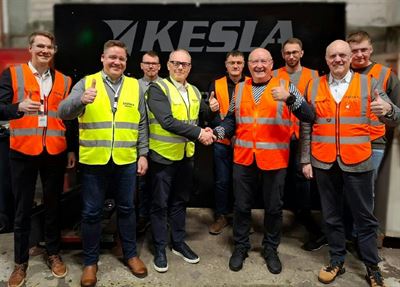
Kesla announced it sold all product rights for its previously discontinued wood chipper product group to Lithuanian UAB Ukmergès Staklès on 17 December 2025, transferring IP, technical support, spare parts inventory and customer/supplier information over a 90‑day handover. The company says the transaction has only a minor financial impact, does not change 2025 guidance, and forms part of a wider restructuring and strategic refocus to concentrate on product groups with clearer competitive advantages. The buyer positions the deal as accelerating its market entry into chippers; Kesla (2024 group turnover €44.3m, ~232 employees, 53% export) expects new OEM cooperation opportunities as a result.
Market structure: The sale removes Kesla as a direct chippers competitor and transfers IP, spare parts and aftermarket obligations to UAB Ukmergès Staklès over a 90‑day handover. Winners are OEM chipper manufacturers and specialist aftermarket providers (potentially improving their margins and OEM bargaining leverage); losers are Kesla’s captive chipper aftermarket revenue (likely <5% of 2024 turnover €44.3m). Expect negligible immediate pricing shock in the broader forestry-machinery market but a modest reallocation of aftermarket share in Europe over 6–18 months.
Risk assessment: Tail risks include warranty or IP disputes, a failed integration by the Lithuanian buyer, or a reputational hit to Kesla if service continuity falters — each could cause short-term customer churn of 2–6% for Kesla’s crane/attachment sales. Immediate impact (days) is immaterial; short term (weeks–3 months) is concentrated on service transfer risk; medium/long term (6–24 months) outcome hinges on Kesla converting freed resources into OEM crane partnerships (upside ~+5–10% revenue if successful). Hidden dependency: Kesla’s crane OEM pipeline may rely on former chipper relationships and could need 3–9 months to rebuild trust.
Trade implications: Favor established global OEMs and Tier‑1 suppliers that can capture OEM opportunities (e.g., Deere (DE), Caterpillar (CAT)) and be cautious on Nordic small‑cap industrials exposed to restructuring. Use directional options to express modest asymmetric upside in DE/CAT over 6–12 months while avoiding binary exposure to Kesla until its structural review delivers quantifiable savings. Cross‑asset: negligible bond/FX moves; monitor Baltic industrial suppliers for idiosyncratic private M&A interest.
Contrarian angles: Consensus will treat this as neutral — we see optionality: Kesla’s divestment could unlock OEM contracts and drive a discrete 3–8% EBIT uplift over 12–24 months if management secures 1–2 major OEM agreements. Conversely, market may underprice transition risk — a service breakdown would be an acquisition target signal for UAB or others, creating M&A opportunities in Baltic machining players. Historical parallel: niche product divestitures often precede supplier consolidation and selective margin expansion for remaining core product lines within 12–18 months.
AI-powered research, real-time alerts, and portfolio analytics for institutional investors.
Request DemoOverall Sentiment
neutral
Sentiment Score
0.10
