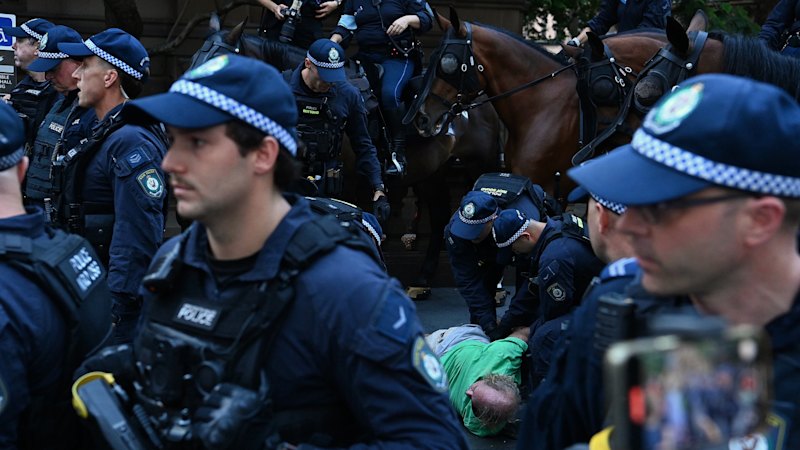
Violent protests in Sydney against Israeli President Isaac Herzog’s visit culminated in a forceful police response and allegations of police brutality, prompting calls for investigations and sharp political criticism from multiple parties. The incident risks turning a diplomatic visit into a domestic political flashpoint and reputational challenge for Australia's authorities, creating localized political risk and potential short-term negative sentiment but with limited direct market implications.
Market structure: Domestic political unrest centered in Sydney materially re-routes short-term demand away from consumer-facing sectors (airlines, hospitality, retail footfall) and toward security/defence, surveillance and private-protection services. Expect localized revenue hits of 5-15% over coming 1-3 months for exposed travel names and small-cap retail landlords; AUD liquidity may weaken intraday on risk-off flow. Cross-asset: AUD likely to underperform vs USD/EUR, ASX small-caps underperform ASX200, and short-term implied volatility on ASX and travel names will rise ~20-40% relative to 30-day realized vol.
Risk assessment: Tail risks include escalation to multi-city unrest (low-probability, <10% over 3 months) that would deepen tourism losses and force state-level regulatory crackdowns that favor security vendors; another tail is a heavy-handed inquiry finding leading to political realignment ahead of elections. Time horizons split: immediate (days) elevated volatility; short-term (weeks-months) demand reallocation; long-term (quarters) reputational damage likely fades absent sustained protests. Hidden dependencies: tourism seasonality, upcoming visits to Canberra/Melbourne within 2–3 weeks, and media narratives can amplify flows faster than fundamentals.
Trade implications: Tactical defensive positioning in AUD and consumer-discretionary travel names is warranted now (days–weeks), while selectively accumulating defence/security exposure on 5–15% pullbacks for 6–12 months. Use options to express directional views to limit tail loss (puts on travel, covered calls or call spreads on defence). Rebalance sector weights away from tourism/intensive retail toward government-contracted suppliers and cybersecurity providers.
Contrarian angles: Consensus focuses on short-term political optics; markets may overprice persistent damage—if protests remain confined, travel revenues should mean-revert within 2–3 months creating short-squeeze opportunities in oversold travel names. Historical parallels (localized protests in major cities) show 6–12 month recovery; unintended consequence: accelerated state spending on security could produce multi-quarter revenue upside for a narrow set of contractors that the market underestimates.
AI-powered research, real-time alerts, and portfolio analytics for institutional investors.
Request DemoOverall Sentiment
moderately negative
Sentiment Score
-0.45
