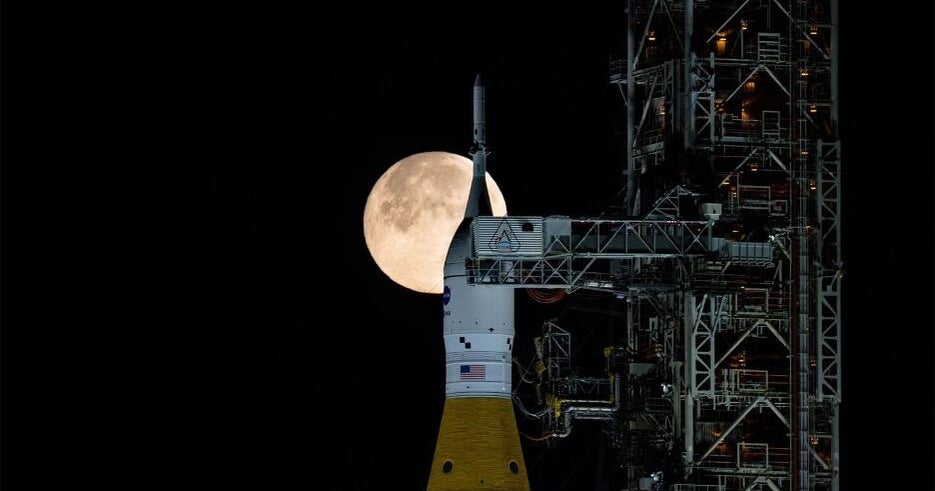
Launch set for Wednesday, April 1 at 6:24 p.m. EDT: Artemis II is a crewed nine-day lunar flyby (Apr 1–10) with four astronauts aboard Orion atop the SLS (≈9 million lbs thrust, 5.7 million lbs liftoff mass). Key technical notes: first crewed SLS/Orion flight, Orion reuses the Artemis I heat shield with a different reentry trajectory, and the mission will reach ~252,000 miles (a new human-distance record). Program context/risk: NASA outlined a ~$20 billion, seven-year plan and sees Artemis II as a critical test ahead of future landings and commercial lander rendezvous; mission is high-profile but unlikely to move broad financial markets.
A successful piloted test materially reduces program execution risk for prime integrators and tier‑1 suppliers, but the commercial benefit is lumpy: most revenue realizations come from follow‑on multi‑year system integration, lander docking work and Gateway construction rather than a single flight. Expect a month‑to‑quarter cadence of contract extensions and inspection/rework orders as NASA digests telemetry; that flow is where public contractors capture cash, not in the launch itself.
Thermal‑protection and parachute system validation are asymmetric value inflection points. A clean run converts engineering risk into backlog and de‑risked cost estimates for future missions—raising bid win probability—whereas even a modest anomaly will spawn expensive corrective programs, warranty charges and procurement scrutiny that compress near‑term margins for specific suppliers.
Geopolitically, a demonstrable human deep‑space capability strengthens allied political cover for higher space/defense appropriations over the next 12–36 months; conversely it also sharpens the commercial debate over expendable high‑cost launchers versus reusable providers, pressuring primes to show competitive cost curves where feasible. Secondary winners include shipyards, recovery/logistics contractors and specialized testing vendors; losers are narrow single‑program small caps with concentrated supplier exposure.
Key catalysts: immediate telemetry and reentry/telemetry releases (days–weeks), NASA program reviews and directed contract awards (3–12 months), and appropriations cycles (12–36 months). Tail risks that would reverse the positive path are a crewed anomaly, repetition of thermal degradation patterns, or political budget retrenchment tied to cost overruns.
AI-powered research, real-time alerts, and portfolio analytics for institutional investors.
Request DemoOverall Sentiment
mildly positive
Sentiment Score
0.15
Ticker Sentiment
