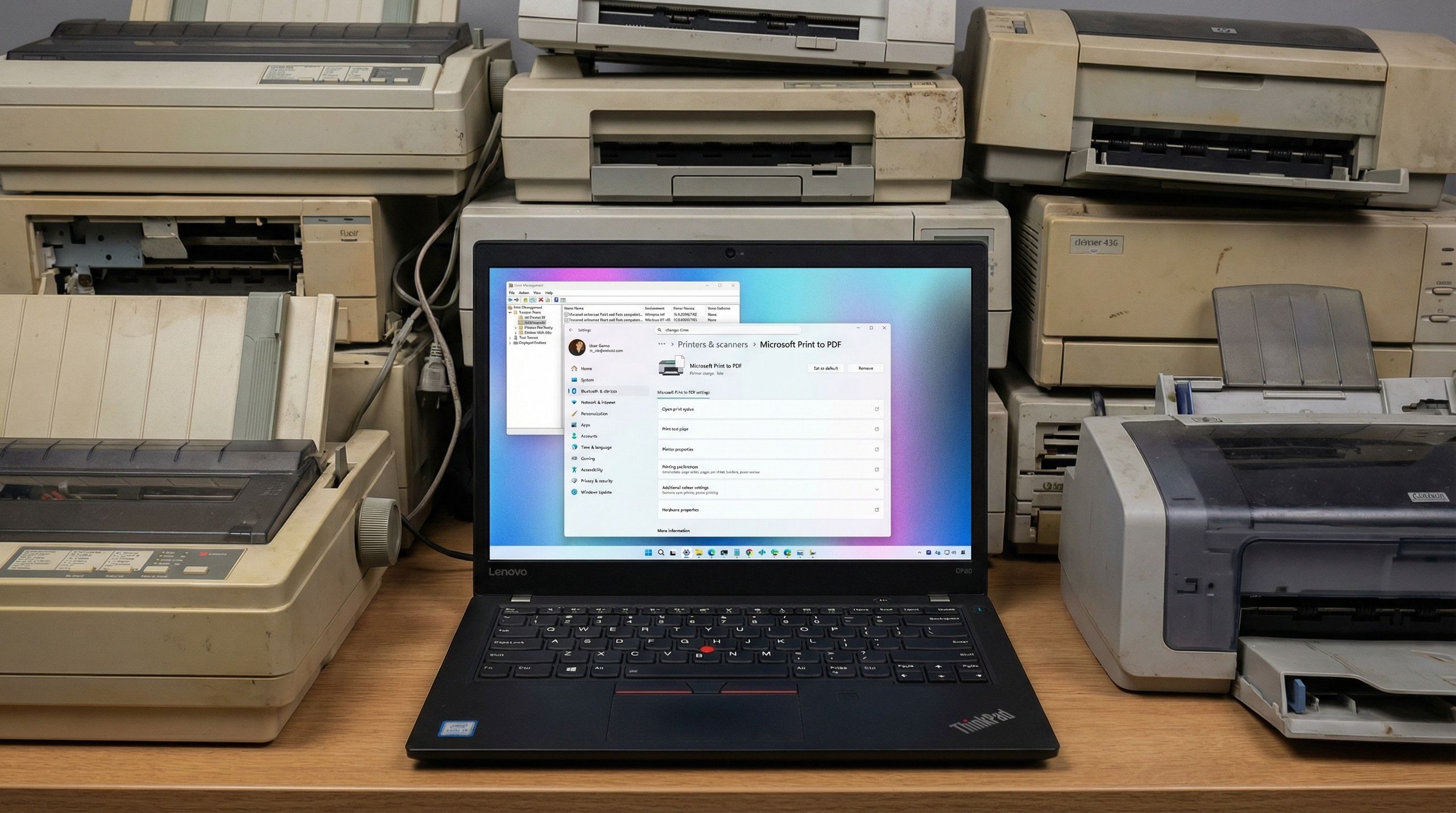
Microsoft will remove support for legacy V3 and V4 printer drivers in Windows 11 beginning with a non-security update (KB5074105) released in January 2026, with the change affecting systems on versions 24H2 and 25H2 as the rollout expands. The deprecation, announced in September 2023, means printers that rely solely on these older drivers may fail to install or stop working, prompting recommendations to update drivers or replace hardware; the move is positioned to reduce security and stability risks and could drive incremental demand for new printers or vendor-supplied driver updates.
Market structure: Microsoft’s deprecation forces a modest replacement cycle concentrated in SMBs, schools and legacy-attached enterprise printers. Winners: OEMs with broad installed bases and channel reach (HPQ) and endpoint/security vendors that reduce driver attack surface (MSFT, CRWD). Losers: legacy-only hardware resellers and long-tail ISV drivers; estimate affected installed base ~5–15% of Windows‑attached printers, implying a near‑term hardware TAM of roughly $0.5–$2bn over 6–18 months.
Risk assessment: Tail risks include OEMs failing to provide drivers (causing contractual liabilities), regulatory pushback on planned obsolescence, or Microsoft pausing/de‑scoping enforcement—each could compress upside by 50–100% relative to base case. Immediate risk (days–weeks) is support-ticket noise and channel returns; short term (1–3 months) is replacement purchasing; long term (3–18 months) is structural shift to managed print services and recurring revenue models. Hidden dependency: OEMs’ channel inventory and SMB CapEx cycles; supply constraints in low‑end ink/toner could amplify price moves.
Trade implications: Tactical long on HPQ to capture replacement hardware (establish 2–3% net long, target 12–25% upside over 6–12 months), small long in MSFT (1–2%) for security positioning, and a 6–12 month call spread on HPQ to limit capital at risk. Pair trade: long HPQ / short ODP (1% each) to express hardware upgrade vs office-retailer margin pressure. Options: buy HPQ 9–12 month 25–35% OTM call spread sized to limit loss to premium; exit on >15% move or positive OEM guidance.
Contrarian angle: Consensus underestimates enterprise inertia—many orgs will seek compatibility shims or third‑party print servers, lowering OEM upside. Conversely, if Microsoft enforces strictly and channel replacement accelerates, OEMs with strong SMB channels could beat estimates. Monitor OEM driver release cadence and Feb 2026 security update adoption (>40% within 30 days = bullish signal for HPQ; <20% = sign enforcement lax).
AI-powered research, real-time alerts, and portfolio analytics for institutional investors.
Request DemoOverall Sentiment
neutral
Sentiment Score
-0.15
Ticker Sentiment
