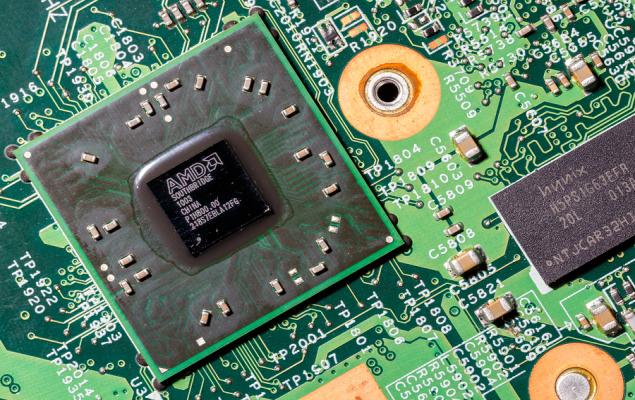
AMD is projecting rapid data-center AI expansion driven by strong demand for Instinct MI350/MI300 families and new Helios rack solutions, with OpenAI selecting AMD to help build 6 GW of next‑generation AI capacity (initial 1 GW rollout in H2 2026). Management now pegs the data‑center TAM at $1 trillion by 2030 (implying >40% CAGR from ~$200B in 2025) and forecasts data‑center AI revenues growing at >80% CAGR over the next 3–5 years, with overall data‑center and total revenues targeting CAGRs of >60% and >35% respectively; Q4 2025 data‑center revenues are expected to grow double‑digit YOY and sequentially. The outlook is tempered by intense competition from NVIDIA and Broadcom and a rich valuation—AMD shares are up ~53% LTM and trade at a forward 12‑month P/S of 8.38x (sector 6.73x); Zacks consensus Q4 2025 EPS is $1.31, ~20% YoY growth.
Market structure: AMD’s Instinct wins (neoclouds, IBM, Cohere, OpenAI tie‑in) expand addressable GPU demand and validate multi‑vendor procurement; short term this increases pricing leverage for GPU suppliers but keeps NVIDIA dominant for high‑end training (Blackwell adoption). Expect hyperscalers and sovereigns to drive >40% data‑center TAM CAGR to $1T by 2030, shifting incremental spend into GPUs, racks (Helios) and smart NICs (Pensando/Broadcom). Supply signals: OEM orderbooks will stay tight through 2026 as large GW builds (OpenAI 1GW in H2 2026; 6GW program) compress channel inventory and lift component lead times.
Risk assessment: Tail risks include OpenAI or other hyperscaler supplier reversals, US/China export controls tightening GPU shipments, or software/ROCm adoption failures that could cut AMD’s 80% AI revenue CAGR thesis by >30% annually. Immediate (days-weeks): earnings and guidance volatility around Q4 2025; short‑term (3–9 months): procurement cycles and backlog updates; long-term (2026–2030): execution of GW rollouts and ecosystem maturity. Hidden dependency: power/energy availability and datacenter cooling constraints—power capex or regional power prices could throttle physical GW installs and raise total cost of ownership by 10–25% in selected regions.
Trade implications: Favor relative plays—long hyperscaler/accelerator leaders and networking winners (NVDA, AVGO, ORCL) and underweight richly priced expectation stocks (AMD equity vs options). Use volatility to structure defined‑risk option spreads around earnings (sell near‑term premium, buy 12–24 month directional spreads to capture H2 2026 Helios/MI450 deployments). Monitor orderbacklog and announced GW commitments as binary catalysts for 20–40% moves.
Contrarian angles: Consensus overweights AMD equity on product news but understates execution and margin pressure from Broadcom XPUs and NVIDIA ecosystem lock‑in—current AMD forward P/S 8.38 vs sector 6.73 implies >20% downside if growth disappoints. Historical parallel: 2016–18 GPU cycles showed vendor share swings can reverse quickly once software stacks standardize (CUDA effect); if ROCm adoption stalls, AMD upside is limited. Unintended consequence: commoditization of rack solutions could compress GPU ASPs by 10–15% as suppliers compete for hyperscaler scale.
AI-powered research, real-time alerts, and portfolio analytics for institutional investors.
Request DemoOverall Sentiment
mildly positive
Sentiment Score
0.25
Ticker Sentiment
