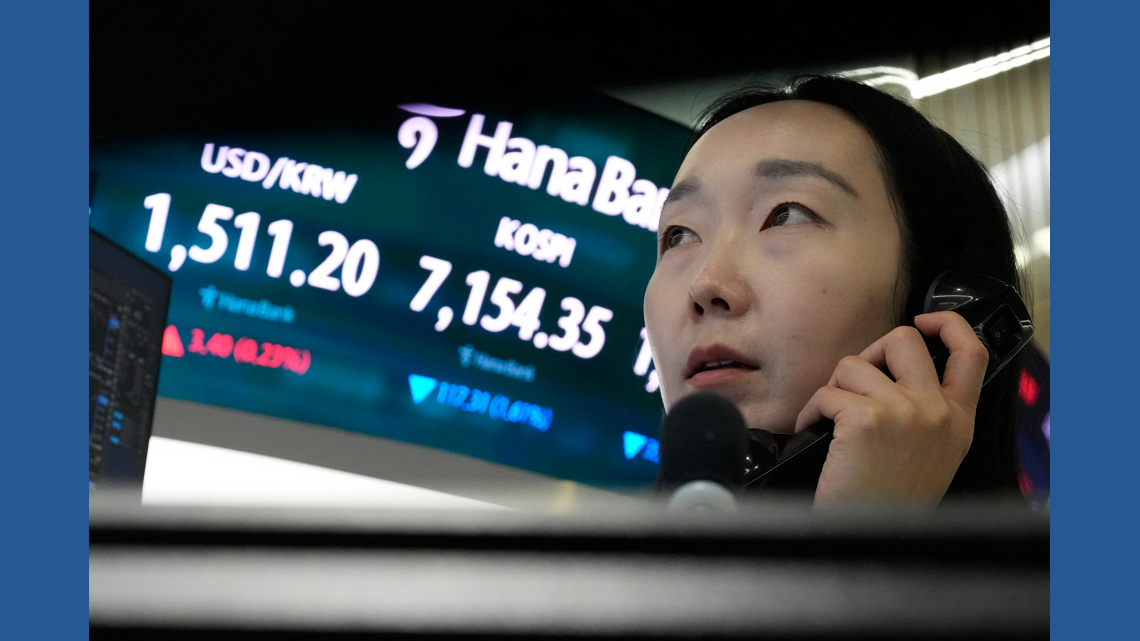
Asian stocks weakened as the 10-year Japanese government bond yield held just below 2.8%, its highest since 1997, while the U.S. 10-year Treasury rose to 4.66% from 4.61% Monday. The rally in AI and tech shares is under pressure ahead of Nvidia's quarterly results, with U.S. futures little changed after the S&P 500 fell 0.7% Tuesday and the Nasdaq dropped 0.8%. Oil remains elevated amid the Iran war, with U.S. crude at $103.70 and Brent at $110.78, reinforcing inflation and rate worries.
The market is transitioning from an earnings-driven multiple expansion regime to a discount-rate regime. That matters most for the AI complex: when the risk-free rate rises faster than forward EPS revisions, the market stops rewarding long-duration growth and starts demanding near-term free cash flow conversion. NVDA is still the bellwether, but the bigger second-order risk is a mechanical de-rating across the entire semiconductor and software supply chain as higher yields raise hurdle rates for data-center capex and make incremental financing less attractive.
The Japan move is a warning sign rather than an isolated local shock. A 10-year JGB near multi-decade highs tightens global term premia by reducing the appeal of yield suppression trades and can force repatriation flows from overseas risk assets, especially U.S. megacap tech. That creates a feedback loop: weaker tech → wider credit spreads → tougher funding for convertible-heavy and levered growth names, which is why AKAM’s financing move is more important than the stock reaction itself. Convert issuance here is often a tell that managements are trying to pre-fund balance-sheet flexibility before spreads widen further.
The contrarian point is that the selloff may still be selective rather than broad-based. HD’s relative resilience suggests the consumer is not collapsing; the real vulnerability is not demand destruction today but margin compression over the next 2-3 quarters if higher fuel and borrowing costs persist. In other words, this is less a recession call than a duration/liquidity call: cyclicals with tangible cash flows can outperform while the market punishes anything priced off distant growth narratives.
Catalyst risk is concentrated into the next 24-72 hours around NVDA. A beat alone may not be enough if guidance does not materially raise near-term revenue or margin assumptions; the stock needs to clear the higher-rate bar, not just the consensus bar. If yields keep rising, the reversal trigger is not just a softer geopolitical headline, but evidence that inflation expectations are rolling over and that funding markets are stabilizing.
AI-powered research, real-time alerts, and portfolio analytics for institutional investors.
Request DemoOverall Sentiment
moderately negative
Sentiment Score
-0.45
Ticker Sentiment
