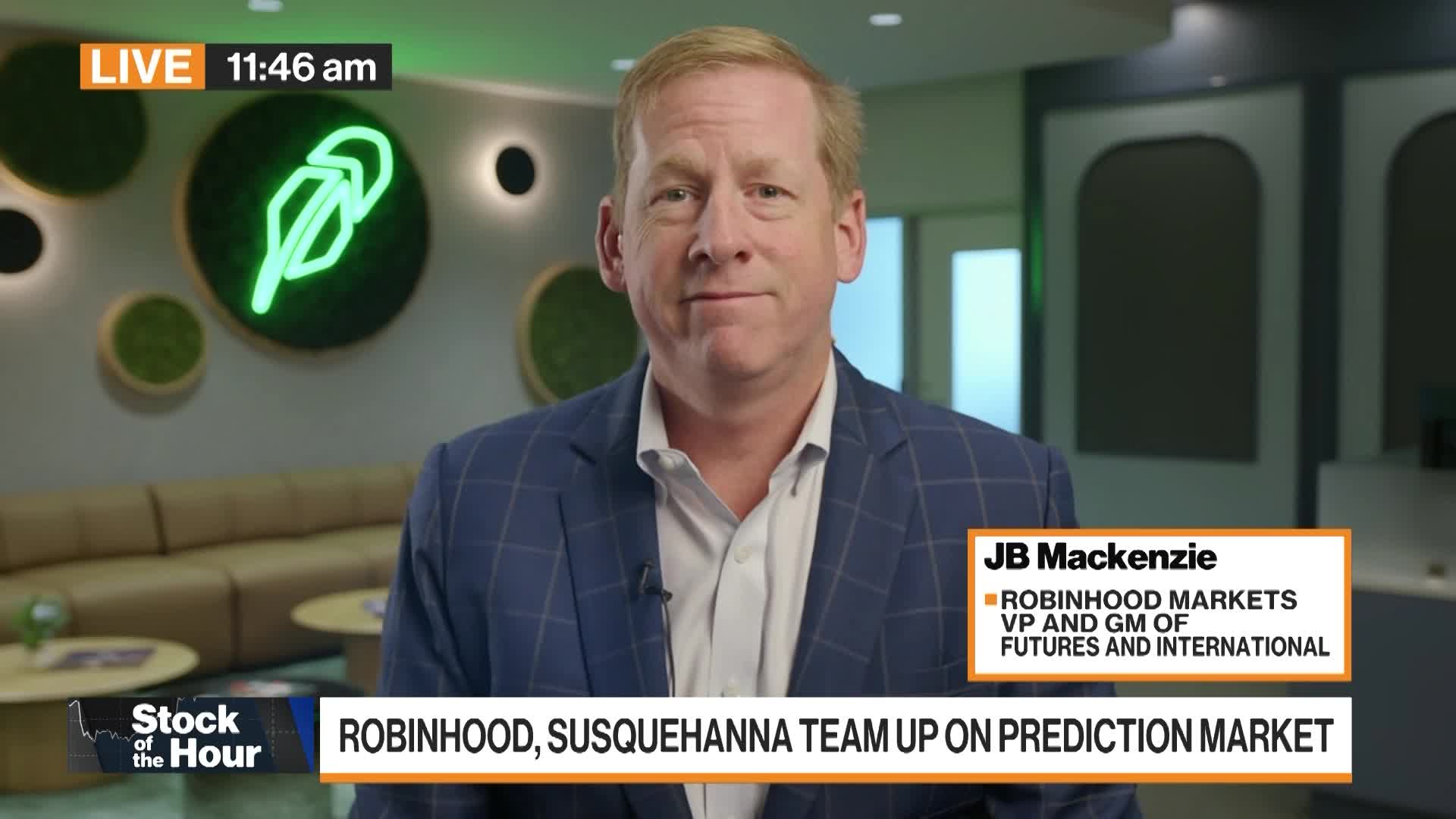
Robinhood is accelerating its push into prediction markets through a minority investment and joint-venture board role (cited as with Cisco Ohana/Susquehanna), positioning itself as both distributor and investor in a CFTC‑regulated exchange and clearing entity. Client engagement has ramped sharply—about 3 billion contracts traded in November (over 20% month-on-month) and more than 9.5 billion contracts since launch—while the firm emphasizes product distribution, liquidity discovery, and active engagement with federal and state regulators to mitigate legal risk. Management argues prediction markets will be additive, potentially onboarding new retail users who may later trade traditional securities on the platform.
Market structure: Robinhood (HOOD) acting as investor/member in a CFTC-regulated prediction-exchange pushes fee capture toward venue operators (CME/ICE analogs) and retail aggregators (HOOD, SCHW). Expect incremental volumes from new users: November showed a >20% MoM spike to ~3B contracts — if sustained at even 50% of that growth rate, clearing/transaction fees could rise by mid-single-digit percentage points for venues over 12–24 months. Incumbent exchanges win on fee economics; pure-play retail platforms win on engagement but face thin per-user monetization.
Risk assessment: Key tail risks are regulatory reclassification (state bans or stricter CFTC rules) and operational/clearing failures that trigger fines — assign ~10–25% downside to HOOD if a major enforcement action occurs within 6–12 months. Short-term (days-weeks) impacts will track headlines and monthly volume prints; medium-term (3–12 months) depends on user conversion rates to equities/futures; long-term (12–36 months) depends on product stickiness and margin per user. Hidden dependencies include liquidity provision (HFT/market-making capacity) and intermediation conflicts that could prompt enforcement.
Trade implications: Direct plays — long exchange operators (CME, ICE) to capture venue fees; selective long HOOD exposure to capture user growth but paired with regulatory hedges. Use options: buy CME/ICE LEAPS (12–24 month calls) and fund HOOD exposure with short-dated call spreads or buy protective puts on HOOD sized to limit drawdown to ~20%. Rebalance as monthly contract volumes deviate ±25% from trend.
Contrarian view: The consensus that prediction markets will ‘feed’ equities volume may be overstated — conversion from curiosity to funded equity traders could be <5% (not 20–30%). That implies exchanges capture most economics (fees/clearing) while brokers absorb acquisition costs. Historical parallel: options growth in the 1990s expanded overall activity but revenue concentrated at exchanges and market-makers; expect similar winner-takes-most dynamics here. Unintended consequence: aggressive in-house product creation could expose retail brokers to conflicts and fines, compressing ROE.
AI-powered research, real-time alerts, and portfolio analytics for institutional investors.
Request DemoOverall Sentiment
moderately positive
Sentiment Score
0.45
