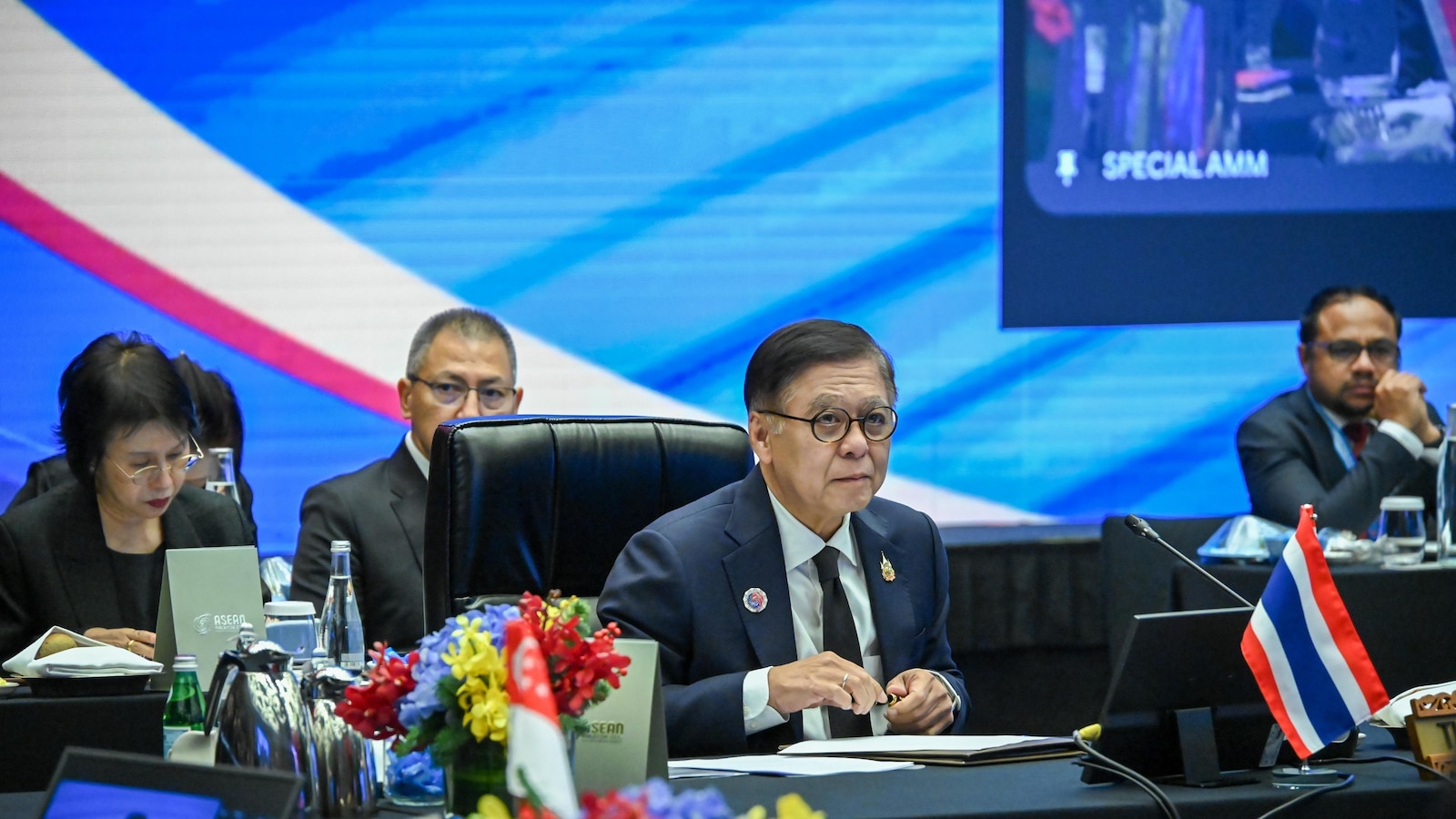
Thai and Cambodian foreign ministers met in China’s Yunnan province for two days of talks after signing a ceasefire that freezes front lines following weeks of fighting that killed more than 100 people and displaced over half a million. The accord includes a 72‑hour observation period and Thailand’s pledge to repatriate 18 Cambodian soldiers; China is mediating the talks, has delivered the first tranche of 20 million yuan in humanitarian aid to Cambodia, and is seeking an expanded role alongside the US and Malaysia in stabilizing the border.
Market structure: A sustained ceasefire shifts near-term winners to Thai tourism, local services and border trade recovery while Chinese construction/aid contractors gain optionality for Cambodia infrastructure work. Direct losers are Cambodian frontier-risk assets, informal cross-border trade intermediaries and short-term humanitarian-risk insurers; expect Thai regional banks and travel-exposed equities to recapture 50–70% of lost daily revenues within 1–3 months if flows resume.
Risk assessment: Tail risks include renewed fighting (low-probability but high-impact) that would widen ASEAN FX spreads and push Thai 2y yields +30–80bps in days; geopolitically, deeper Chinese mediation could lock in longer-term BRI financing for Cambodia, raising Chinese SOE contract wins over 6–24 months. Key horizons: immediate (0–14 days) = volatility and FX swings; short-term (1–3 months) = tourism and trade normalization; long-term (6–24 months) = structural Chinese influence and infrastructure flows.
Trade implications: Tactical buys: Thailand equity ETF (THD) and select Chinese construction/heavy civil names (e.g., 1800.HK) on bid; trim or avoid Cambodia/frontier exposure and EM frontier funds with >5% Cambodia weight. Use options to hedge tail risk (cheap 3-month 10–25-delta puts on THD or a 3-month put spread on EEM sized to 0.5–1% of portfolio) and consider 10y Thai local bonds as a 30–50bp duration play if ceasefire holds.
Contrarian angles: Consensus underestimates the signaling value of Chinese mediation — if Beijing scales aid beyond the current RMB20m it can spur multi-quarter construction contracts, underpricing Chinese contractors and ASEAN infrastructure plays today. Conversely, the market may be underpricing a quick reversal; set hard stop-losses (6–8%) and watch for 72-hour observation outcomes and printer-test metrics (soldiers’ repatriation, first aid disbursement >$50k) as binary catalysts within 7–14 days.
AI-powered research, real-time alerts, and portfolio analytics for institutional investors.
Request DemoOverall Sentiment
neutral
Sentiment Score
0.12
