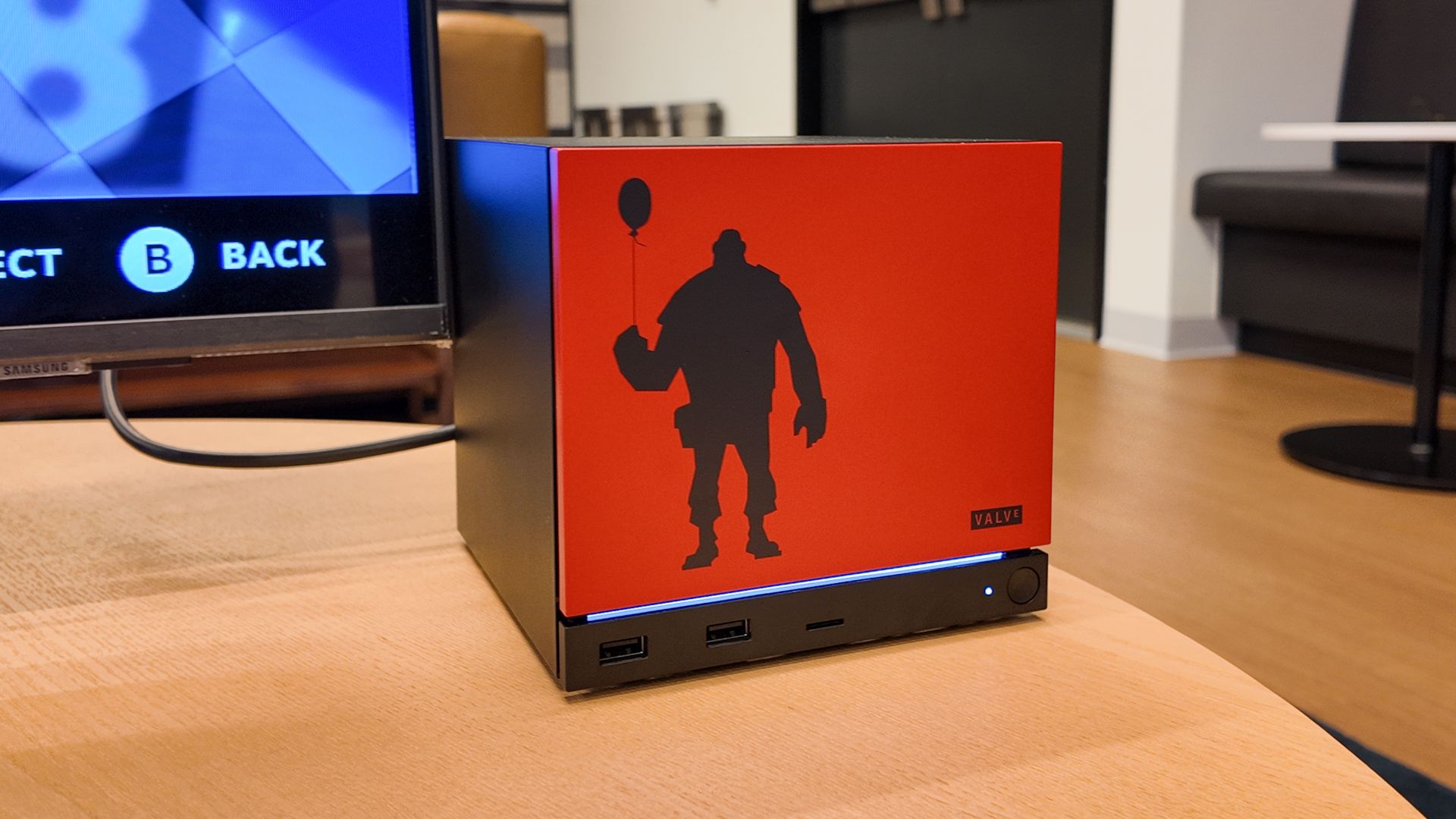
Valve engineer Pierre‑Loup Griffais confirmed the forthcoming Steam Machine will be priced roughly in the same window as a similarly performing PC build rather than being subsidized like a traditional console, with pricing still under refinement. Valve is positioning the product to command a potential premium for living‑room features—small form factor, TV/remote integration and low noise—while PC Gamer staff estimate an average consumer expectation around $525; industry benchmarks suggest competing midrange PC builds (e.g., RTX 5060) cost roughly $750–$800, implying that a materially higher retail price could hinder adoption.
Market structure: A Valve Steam Machine priced at PC-comparable levels preserves pricing power for discrete GPU makers (NVDA, AMD) and foundry/capex suppliers (TSM, LRCX) while limiting upside for console OEMs (SONY, MSFT) if adoption scales. If retail settles near $525 demand elasticity may broaden addressable living-room PC buyers; if retail drifts toward $750–$800 adoption will be supply-constrained to enthusiasts, leaving incumbents’ unit economics intact. Downstream, midrange component order volatility could compress short-term OEM inventories but should be neutral-to-positive for semiconductor cyclical demand over 3–18 months. Cross-asset: modest upside for semiconductor equities and capex; negligible immediate FX/commodity moves, but corporate credit spreads for consumer-electronics retailers (BBY) could widen if substitution reduces sell-through by >10% over a quarter.
Risk assessment: Tail risks include a failed OS/driver ecosystem leading to high return rates and warranty liabilities, or a regulatory push if Valve bundles platform services—each could depress hardware orders by 20–40% in a downside scenario. Immediate (days) impact is limited to price/rumor trades; short-term (30–90 days) hinge on announced MSRP and launch cadence; long-term (12–36 months) depends on developer support, streaming competition (MSFT/NVIDIA cloud gaming) and replacement cycles. Hidden dependencies: attach rates for premium GPUs, Steam Store revenue share, and Valve’s channel strategy (direct vs. retail) will nonlinearly affect component demand. Catalysts: official MSRP within 30–60 days, developer support announcements, and holiday-season preorders.
Trade implications: Favours long exposure to NVDA and TSM (benefit from discrete GPU demand and foundry orders) with conditional sizing tied to announced MSRP; small tactical short on BBY if price signals material console/retail substitution. Options: favor long-dated call spreads (NVDA Jan 2026 450/600) to cap cost while capturing secular GPU upside; avoid event-driven near-dated straddles absent clear launch date. Sector rotation: overweight semiconductors and capex suppliers, underweight consumer-electronics retail and mid-tier console accessories for 3–12 months. Timing: wait for MSRP within 30–60 days for scale decisions; initiate small, hedged exposure beforehand to capture pre-announcement skew.
Contrarian angles: Consensus expects modest consumer price sensitivity; market underestimates developer and ecosystem risk — if Valve targets $525 but fails to secure living-room UX parity, adoption could be <25% of forecasts. Reaction could be underdone for suppliers: even a modest Steam Machine share gain (5–10% of PC installs) materially increases lifetime GPU demand by 5–7% over 24 months, favouring NVDA/TSM. Historical parallels: niche console-like PC launches (e.g., Ouya) show that ecosystem and pricing—not raw specs—determine success; Steam Deck’s stronger-than-expected attach rates suggest Valve can convert users if price/UX align. Unintended consequence: aggressive premium pricing could push consumers toward cloud gaming, capping hardware growth and shifting value to MSFT/NVIDIA services instead of silicon sales.
AI-powered research, real-time alerts, and portfolio analytics for institutional investors.
Request DemoOverall Sentiment
neutral
Sentiment Score
-0.05
