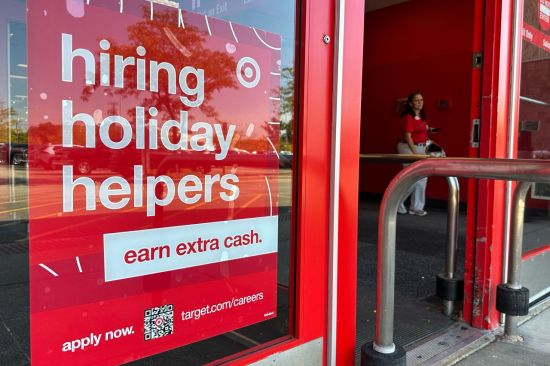
A Yale School of Management CEO-conference survey reported 66% of executives plan to cut or maintain headcount in 2026 while only one-third expect to hire, as firms cite AI-driven efficiency gains and tariff-related economic uncertainty. Macro indicators show a cooling labor market — unemployment rose from 4.4% in September to 4.6% in November — and firms including Amazon, Verizon, Target and UPS have trimmed office roles; IBM’s voluntary turnover has fallen below 2% (vs ~7% historically), reducing hiring needs. Despite a stronger-than-expected 4.3% annualized Q3 GDP print, the dominant corporate strategy appears to be ‘do not hire,’ which could cap payroll growth and weigh on consumer-facing sectors if sustained.
Market structure: The hiring freeze favors scale players that can substitute labor with AI — cloud and chip names (NVDA, MSFT, GOOGL, AMZN/AWS) gain pricing power for compute and software while labor-heavy retailers/logistics (TGT, UPS, AMZN’s fulfillment) lose leverage and face margin pressure. The WSJ CEO poll (66% pausing or cutting hires) implies lower wage pressure: expect downward pressure on labor-sensitive input costs and consumer services demand over 3–12 months. Smaller competitors lacking AI investment budgets will cede share to incumbents, compressing retail/transportation margins by an estimated 200–400bps if automation substitutes 5–10% of payroll over 12–24 months.
Risk assessment: Tail risks include regulatory intervention (AI taxation or worker protections) and supply shocks in GPUs/semiconductors that could push compute costs +30–50% short-term; union actions at UPS/Amazon or tariff escalations are 10–20% downside shocks for logistics. Immediate window (days) will see earnings rehypothecation; short-term (weeks–months) hiring-data and quarterly guidance will drive repricing; long-term (quarters–years) outcomes depend on successful AI integration, capex cycles, and consumer demand elasticity. Hidden dependencies: productivity gains require skilled labor and capex; failure raises stranded-asset risk in automation investments.
Trade implications: Overweight AI infrastructure and cloud for 6–18 months (NVDA, MSFT, GOOGL, AMZN AWS exposure) and underweight/short TGT and UPS due to secular demand risk and margin compression. Use pair trades (long NVDA vs short TGT) to isolate AI vs retail risk, and buy-duration (2–5yr Treasuries) if wage growth (AHE) falls below 3.5% for two consecutive months. Options: buy 6–9 month call spreads on NVDA/MSFT to cap cost and buy puts on TGT/UPS to hedge operational tail risk.
Contrarian angles: Consensus overlooks that capex to AI can temporarily boost equipment/semiconductor cyclicality and keep tech multiples supported even as payrolls fall; market may be underpricing NVDA/MSFT fundamentals if AI revenue ramps >20% YoY. Conversely, downside may be underdone in retail/logistics where job insecurity reduces discretionary spend — a faster consumer pullback (GDP growth <2% QoQ annualized) would force inventory markdown cycles and amplify downside. Unintended consequence: rapid automation could trigger political/regulatory tightening in 12–24 months, creating a mid-term risk to AI winners' margins.
AI-powered research, real-time alerts, and portfolio analytics for institutional investors.
Request DemoOverall Sentiment
moderately negative
Sentiment Score
-0.35
Ticker Sentiment
