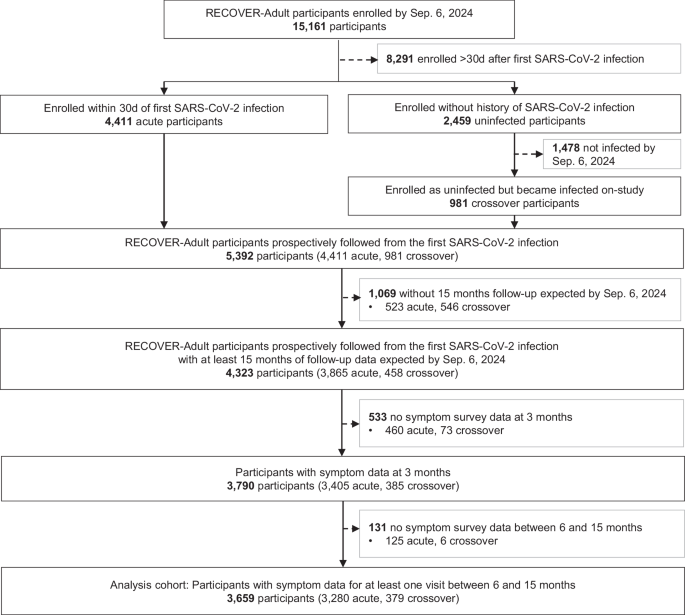
In a prospective RECOVER-Adult study of 3,659 predominantly Omicron-era, non-hospitalized participants followed 3–15 months after first SARS-CoV-2 infection, investigators used a standardized Long COVID Research Index to identify eight distinct symptom trajectories: 5% had a persistently high symptom burden, 12% had intermittently high symptoms, and 14% experienced delayed or worsening symptoms. Approximately 10% met the Long COVID threshold at 3 months, of whom 46% remained persistently symptomatic, 35% had intermittent symptoms and 19% improved by 15 months; 36% of participants reported reinfection by 15 months, marginally higher in worsening trajectories. The clear heterogeneity and identifiable subgroups have practical implications for targeting clinical-trial enrollment, biomarker discovery, healthcare resource planning and the market for therapeutics and long-COVID services, while generalizability beyond the Omicron era and beyond 15 months remains limited.
The RECOVER-Adult prospective cohort (n=3,659; 69% female; 99.6% infected in the Omicron era; 98% non-hospitalized) used a standardized Long COVID Research Index (LCRI, range 0–30; Long COVID defined as LCRI ≥11) at 3, 6, 9, 12 and 15 months and identified eight distinct longitudinal symptom trajectories. Numerically, 195 participants (5%) had persistently high symptom burden (profile A), 443 (12%) had intermittently high burden (profile B), 526 (14%) showed delayed/worsening symptoms (profiles E and F), and 1,301 (36%) never met the threshold (profile H); 374–324 (≈10%) met criteria at 3 and 15 months respectively. Among the 377 who met LCRI ≥11 at 3 months, 46% remained persistently symptomatic, 35% had intermittent symptoms and 19% improved by 15 months.
The study’s strengths—frequent serial measurement, finite mixture modeling and multiple imputation—support credible subgroup identification for trial targeting and biomarker work, but limitations constrain generalizability: the cohort is largely Omicron-era, non-hospitalized, missing symptom data 8–16% per visit with higher attrition among those with highest LCRI, and follow-up is limited to 15 months. Reinfections were reported by 36% overall and were marginally higher (39–40%) in worsening profiles, but reinfection did not clearly explain delayed worsening.
For healthcare and biotech markets, the presence of a reproducible ~17% subgroup with persistent or intermittent high symptom burden over 15 months highlights a definable addressable population for therapeutics, diagnostics and long-COVID services. Uncertainty about longer-term trajectories and era-specific prevalence (lower than pre-Omicron) argues for cautious, selective investment tied to trials that use these trajectory-defined enrollment criteria and for monitoring longer follow-up data to de-risk exposure.
AI-powered research, real-time alerts, and portfolio analytics for institutional investors.
Request DemoOverall Sentiment
neutral
Sentiment Score
0.00
Ticker Sentiment
