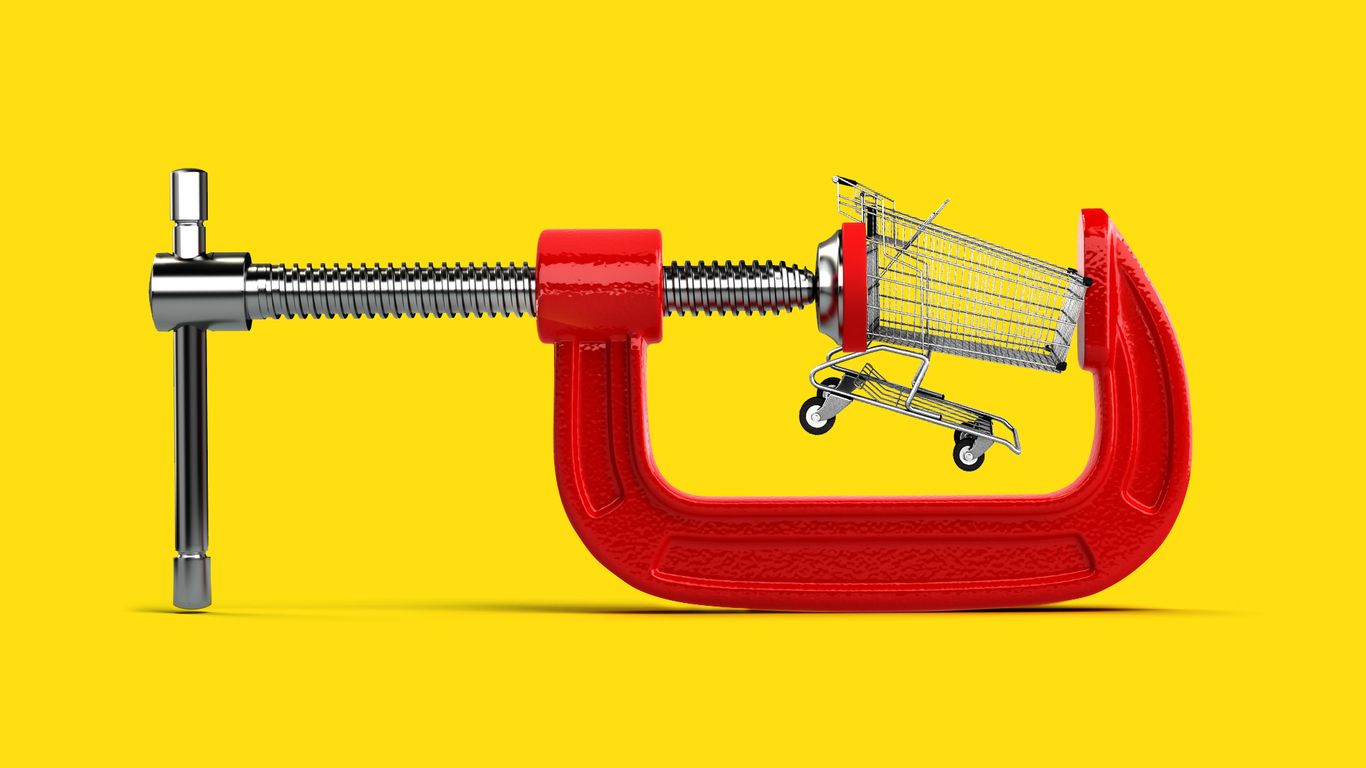
Lower-income Americans are showing clear financial strain, with the personal savings rate at 3.6% in March, the lowest since 2022, and the University of Michigan consumer sentiment index at its weakest level since 1952. New York Fed data show households earning under $40,000 cut gas purchases by 7% in March but still spent 12% more on gasoline, while companies including Kraft Heinz, McDonald's, Whirlpool and Walmart are warning that lower-end consumers are stretched. The article points to a widening K-shaped economy that could pressure consumer-facing companies and signal a slowing economy.
The key equity implication is not a broad consumer collapse; it is a widening dispersion in unit economics. Low-end demand is being forced to trade down, reduce basket size, and stretch purchase intervals, which helps discounters and food-at-home names at the expense of discretionary durables, premium grocery mix, and brands with limited private-label insulation. That tends to show up first in margin pressure rather than revenue decline, because retailers can still post traffic while suppliers absorb more promo intensity and unfavorable mix.
The second-order effect is that energy inflation acts like an involuntary tax on the bottom half of consumers, but the transmission is asymmetric by category. Anything tied to replacement purchases or big-ticket financing is vulnerable over the next 1-2 quarters as households prioritize essentials; that is a tougher setup for WHR than for the other names because deferred appliance demand can persist long after the initial gas shock fades. For MCD and WMT, the issue is not traffic collapse but mix: higher-income customers can mask weakness in lower-income cohorts, but that usually compresses margins as value offerings and promotions carry the sales line.
The contrarian view is that the market may be over-pricing a near-term recession signal and under-pricing the possibility that the savings drawdown is still an adjustment to sticky inflation rather than a true demand air pocket. If gas stabilizes, low-end spending can reallocate quickly into food, household staples, and convenience channels, which makes the current signal more of a rotation than an outright demand destruction story. The most fragile setup is if labor softness starts to join the energy shock; absent that, this is more a stock-picker environment than a macro short.
AI-powered research, real-time alerts, and portfolio analytics for institutional investors.
Request DemoOverall Sentiment
moderately negative
Sentiment Score
-0.35
Ticker Sentiment
