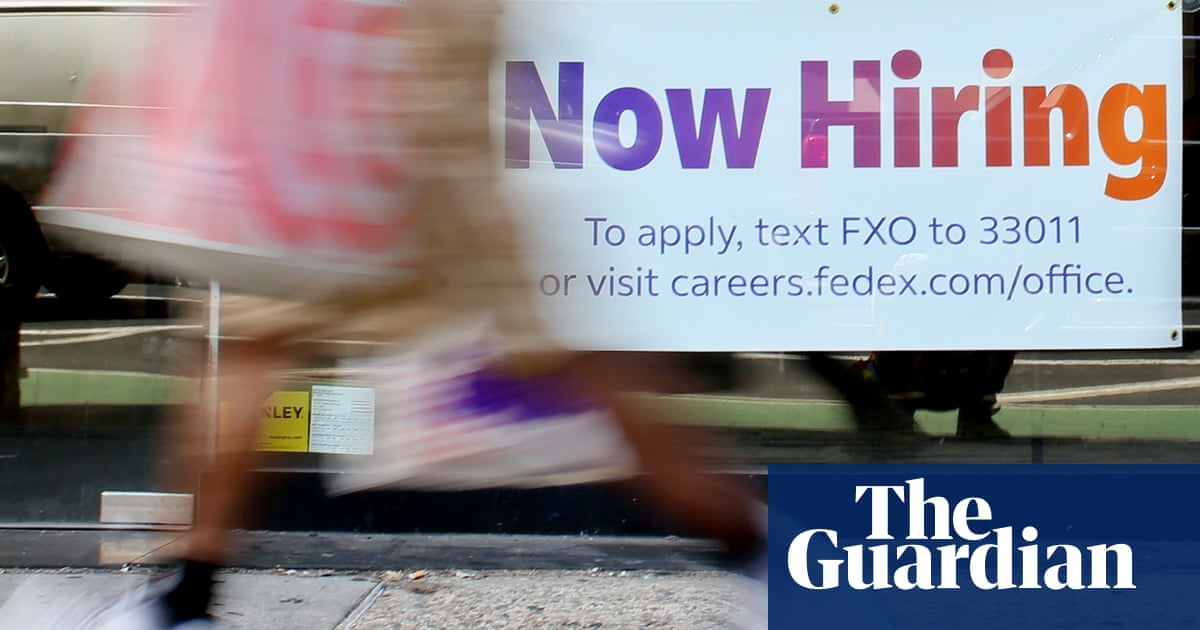
The US economy added 139,000 jobs in May, a slowdown from the previous month, while the unemployment rate remained steady at 4.2%; this was below expectations and reflects a cooling labor market amid trade war uncertainty, evidenced by downward revisions to prior months' job creation and a loss of 22,000 federal jobs due to government efficiency initiatives. Economists are closely monitoring trade talks between the US and China, as well as the potential impact of tariffs on inflation, with consumer sentiment remaining relatively stable but near a multi-year low.
The U.S. economy exhibited a notable deceleration in job creation during May, with nonfarm payrolls increasing by only 139,000, a marked slowdown from the prior month, underscoring the impact of ongoing trade uncertainties and specific governmental actions. This slowdown is further amplified by the Bureau of Labor Statistics' downward revision of job creation for March and April by a cumulative 95,000. The unemployment rate, however, remained unchanged at 4.2%. A significant contributor to May's weaker figures was a reduction of 22,000 federal government positions, part of a broader cut of 59,000 federal jobs since January under the "department of government efficiency" initiative. Private sector hiring also showed weakness, with ADP reporting an increase of just 37,000 private-sector payrolls in May, the smallest gain in over two years, prompting ADP's chief economist Nela Richardson to state that hiring is "losing momentum." Further corroborating a cooling economic landscape, the Institute for Supply Management's purchasing managers' index for manufacturing registered 49.9 in April, its lowest level since June 2024, indicating contraction in the sector. While consumer sentiment, per the University of Michigan's survey, was relatively stable from April to May, this followed April's significant drop, which was the largest since 1990. Inflationary pressures from tariffs have not yet manifested significantly, with the annual inflation rate at 2.3% in April, though economists anticipate a gradual impact. The market remains highly sensitive to U.S.-China trade relations, which have seen recent volatility including a breakdown in talks, subsequent reports of a "very positive" call between presidents, and mutual tariff reductions (U.S. tariffs on Chinese imports from 145% to 30%, China's on U.S. goods from 125% to 10%). Legal challenges to the Trump administration's tariffs add another layer of uncertainty, despite an appeals court reinstating them after a brief block. The overall sentiment reflected in the data signals is strongly negative, with a pessimistic tone and a high market impact score, indicating significant investor concern.
AI-powered research, real-time alerts, and portfolio analytics for institutional investors.
Request DemoOverall Sentiment
strongly negative
Sentiment Score
-0.70
Ticker Sentiment
