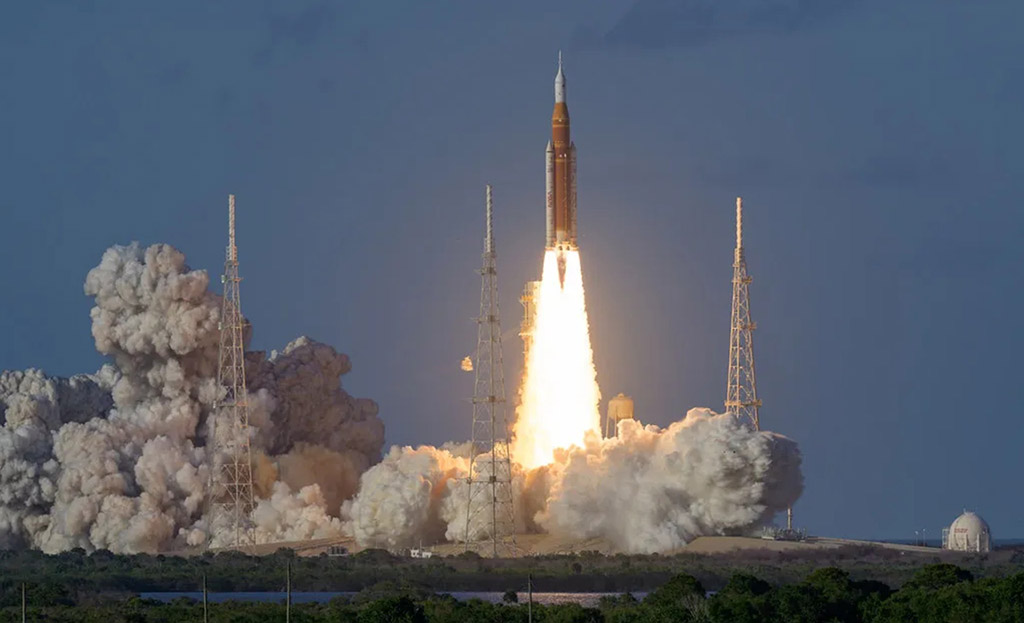
NASA launched Artemis II aboard the SLS from Kennedy Space Center, carrying four astronauts on the first crewed lunar flyby in over 50 years. The roughly 10-day test mission will exercise Orion's life‑support and navigation systems in deep space, loop around the Moon (including far-side observations) and conclude with a Pacific Ocean splashdown.
This step-change in sustained lunar activity is less about a single mission and more about a multi-year ramp in demand for high-reliability aerospace subsystems — think avionics, radiation-hardened semiconductors, precision turbomachinery and long-duration life-support components. These product categories typically clear multiple $100M–low‑B contract awards per program year; expect tier-2/3 suppliers with flexible capacity to see revenue cadence reprice over a 12–36 month window as NASA and primes move from development into sustained cadence and sustainment.
Competitive dynamics favor integrated primes that can cross-sell mission engineering, launch services and long-lead hardware, but second-order winners are often niche suppliers (MRO, propulsion injectors, thermal blankets, rad-hard ICs) where barriers to entry are technical rather than scale-based. Conversely, commercial launch vendors that undercut cost per kg may win future lander/transport roles; that threat compresses long-term pricing power for heavy-lift bespoke systems absent policy-protected budgets.
Risk is heavily binary and front-loaded: schedule slips, a high-profile anomaly, or a shift in Congressional appropriations can reverse the positive narrative quickly — expect valuation re-rates within days of a major technical setback, and budgetary churn on the 6–18 month appropriations cycle. Over a 3–5 year horizon the biggest tail risk is policy pivot to commercial providers; hedging that structural outcome is the key portfolio decision.
From a signals perspective, watch subcontract award flow, lead-time extensions for radiation-hardened components, and spare-parts procurement patterns — they precede durable revenue recognition by 6–12 months and tell you whether this is a transient PR event or a sustained industrial policy-led demand shock.
AI-powered research, real-time alerts, and portfolio analytics for institutional investors.
Request DemoOverall Sentiment
mildly positive
Sentiment Score
0.35
