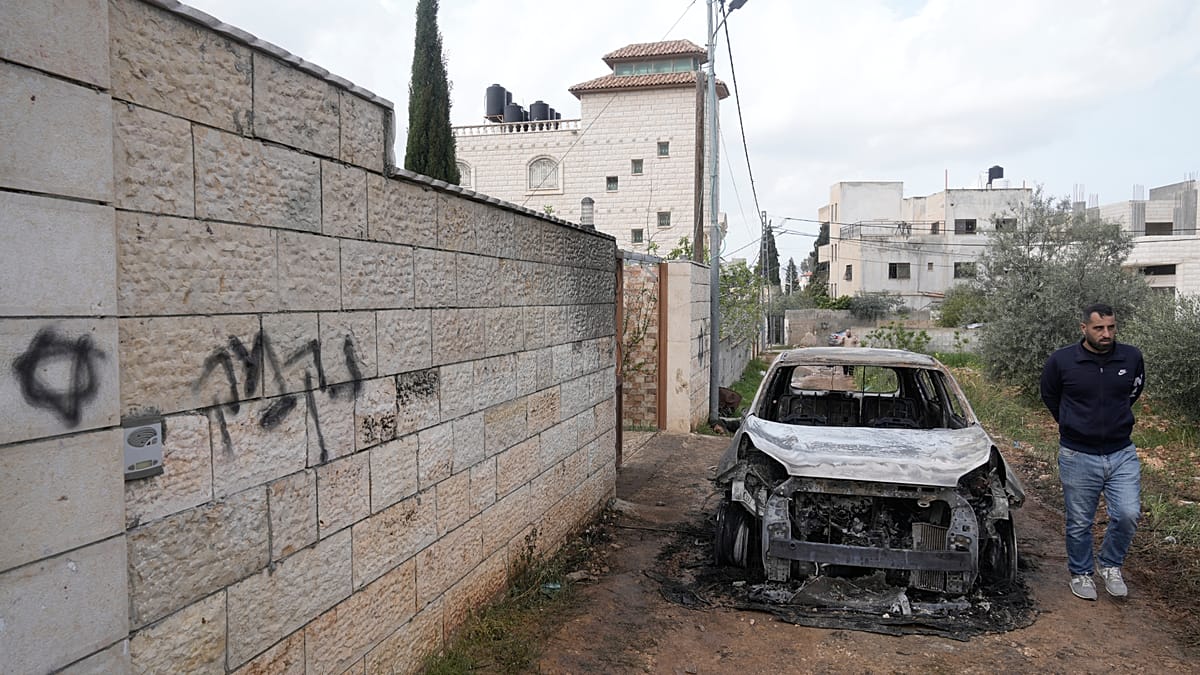
A Prime Minister’s directive issued 25 March orders IDF reinforcement in the West Bank and the diversion of troops from Lebanon—the first such withdrawal from an active front—to crack down on settler violence. The directive bans new outposts in Area B, mandates economic sanctions on settlers who illegally build outposts, and creates a Defence Ministry unit to address the 'Hilltop Youth.' OCHA data cited: >1,800 settler attacks, ~1,600 Palestinians displaced, 240 Palestinians and 17 Israelis killed in 2025; the West Bank hosts ~700,000 settlers and ~3.8M Palestinians; IDF chief warns the army is near collapse due to manpower shortages across Gaza, Lebanon, Syria and the West Bank.
Netanyahu’s move to reallocate security resources domestically creates a classic capacity shock: forces and materiel that were de‑risking northern and southern fronts are now being re-tasked to internal stability operations, raising the probability of localized escalation elsewhere. That rebalancing compresses near‑term operational depth and should mechanically lift demand for ISR, force‑protection, and air‑defense systems within a 1–6 month window as commanders seek compensatory technology and munitions to plug gaps.
A domestically focused crackdown plus financial penalties on illegal outposts shifts the marginal economics of settlement‑driven construction: developers and suppliers who priced revenue growth off accelerated approvals face 6–18 month headwinds, while non‑domestic contractors and insurers will increasingly price counterparty and compliance risk into contracts. Simultaneously, political friction with hardline ministers raises event risk for policy U‑turns that could tighten or loosen regulation quickly — amplifying short‑term volatility in Israeli equities and credit spreads.
Market secondaries: expect a bifurcation — defense/ISR names and US majors with Israel exposure should see re-rating tailwinds, while Israeli domestic cyclical sectors (construction, local banks, real estate) and long‑duration sovereign paper face outsized downside if instability persists. Currency moves (ILS weakening 3–7% under sustained unrest) would be a fast signal that markets are repricing sovereign risk and contagion to EM/CEE flows.
Contrarian caveat: this is not a permanent reallocation — political calculus and international pressure can reverse troop movements within weeks, making a pure defense long vulnerable to a policy reversal. Trades should therefore favor directional exposure that can be paired or hedged, and be sized to survive 6–12 weeks of mean reversion risk before the fundamental demand uplift becomes visible in procurement budgets.
AI-powered research, real-time alerts, and portfolio analytics for institutional investors.
Request DemoOverall Sentiment
strongly negative
Sentiment Score
-0.60
