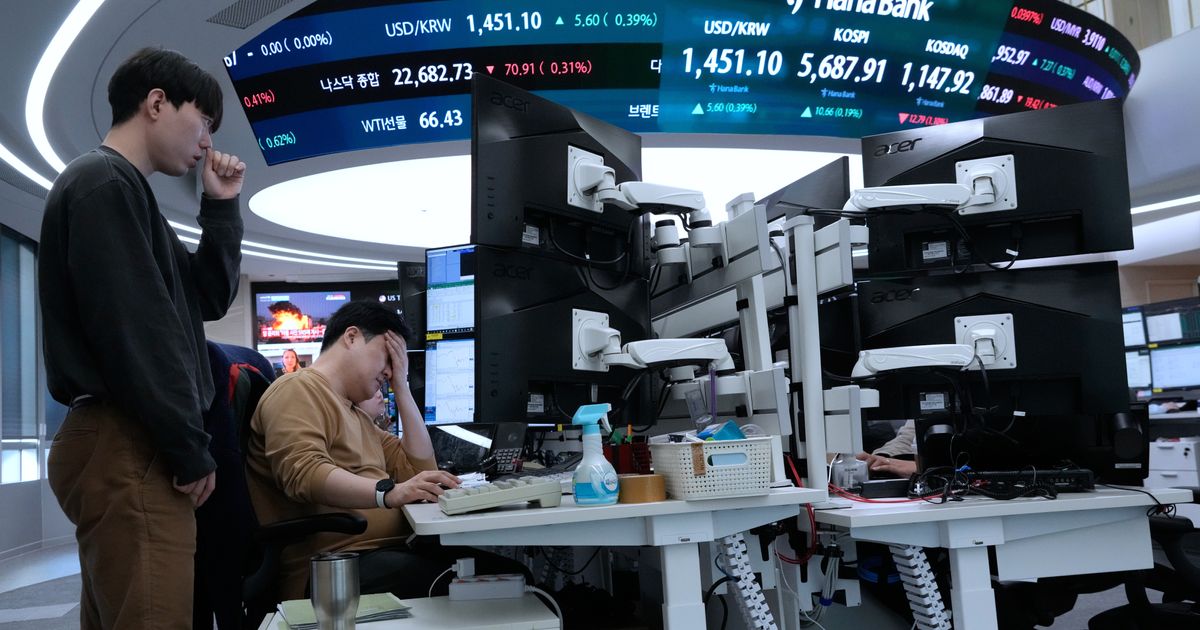
European benchmarks ticked higher (DAX +0.2 to 25,103.32, CAC 40 +0.7 to 8,460.35, FTSE 100 +0.4 to 10,672.75) after a mixed Asian session where Tokyo’s Nikkei fell 1.1% to 56,825.70 and Hong Kong’s Hang Seng dropped 1.1% to 26,413.35 while South Korea’s Kospi surged 2.3% to 5,808.53. Markets are wrestling with downside risks from massive AI-related private-credit exposure (MUFJ -2.2% after partner Blue Owl -5.9%), corporate weakness (Booking -6.1%; Walmart swung from +2.7% intraday to -1.4% after guidance), and higher oil (U.S. crude near $66.20/bbl, Brent $71.49) amid U.S.-Iran tensions that could delay Fed rate cuts; gold (+1%), silver (+2.7%) and bitcoin (~$68,135) also rose while the dollar strengthened versus the yen.
Market structure: Winners in the near term are energy producers and defense contractors (oil up ~1.9%, Hanwha Aerospace +6.4%) and safe-haven commodities (gold +1%), while AI-exposed incumbents and private-credit lenders (BKNG -25% YTD, OWL down on Blue Owl weakness, MUFG partnership risk) are immediate losers. Competitive dynamics favor capital-light AI platforms and defense suppliers; travel/OTA pricing power is at risk if AI-driven disintermediation materializes, putting downward pressure on margins and raising customer-acquisition costs by an estimated 200–500 bps for vulnerable players over 12 months. Supply/demand: geopolitics-driven oil upside tightens physical balances — a sustained Brent >$75 for two weeks would materially increase export revenues for majors and delay Fed cuts. Cross-asset: expect wider credit spreads, higher front-end FX volatility (USD/JPY moves), increased equity option skew and a flatter yield curve if inflation expectations re-accelerate.
Risk assessment: Tail risks include a US–Iran kinetic escalation (weeks) pushing Brent >$85 and equity volatility >VIX+40 pts, or a private-credit cascade from a major OWL default that widens HY spreads by 200–400 bps (months). Immediate (days) is risk-off trading and headline-driven moves; short-term (1–3 months) brings earnings downgrades for BKNG/consumer tech and potential credit-rating pressure on banks with private-credit exposure; long-term (quarters) winners are platform AI providers, defense, and energy capex winners. Hidden dependencies: MUFG/other banks' counterparty exposure to illiquid private-credit NAVs and gating risks; second-order: higher oil could accelerate EM FX stress and sovereign credit costs. Catalysts: Iran nuclear talks, Fed commentary on cuts, major AI product rollouts, and private-credit NAV marks/quarterly reports.
Trade implications: Direct plays — establish ~2% long in defense exposure (ITA) and 1–2% long in energy (XLE or 3‑month WTI 70/85 call spread) as tactical hedges for 1–3 month horizon; initiate 1–2% short in BKNG via outright stock or 3‑month 15% OTM puts (stop +12%) targeting 15–25% downside. Relative value: pair long ITA vs short BKNG (1:1 notional) to exploit rotation from consumer discretionary to defense over 1–3 months. Options strategies: buy 3‑month puts on OWL (0.5–1% notional) and buy 2–3% portfolio tail protection via 3‑month S&P500 10–15% OTM puts if Brent >$80 or VIX spikes >25.
Contrarian angles: The market likely overprices structural AI disruption in the short term — BKNG’s 25% YTD drop may be an overreaction if management sustains unit economics; consider covered-call overlays on selectively bought travel names after a 10–15% recovery. Historical parallels: 2014–16 oil/geo shocks created 6–12 month outperformance for quality energy names once prices stabilized; similarly, a temporary credit scare can create attractive entry points in high-quality banks (MUFG) if contagion remains contained. Unintended consequence: persistent oil upside could force the Fed to delay cuts, boosting banks' NIMs but hurting rate-sensitive growth stocks — monitor Brent >$80 and Fed dot-plot changes as binary triggers.
AI-powered research, real-time alerts, and portfolio analytics for institutional investors.
Request DemoOverall Sentiment
mildly negative
Sentiment Score
-0.25
Ticker Sentiment
