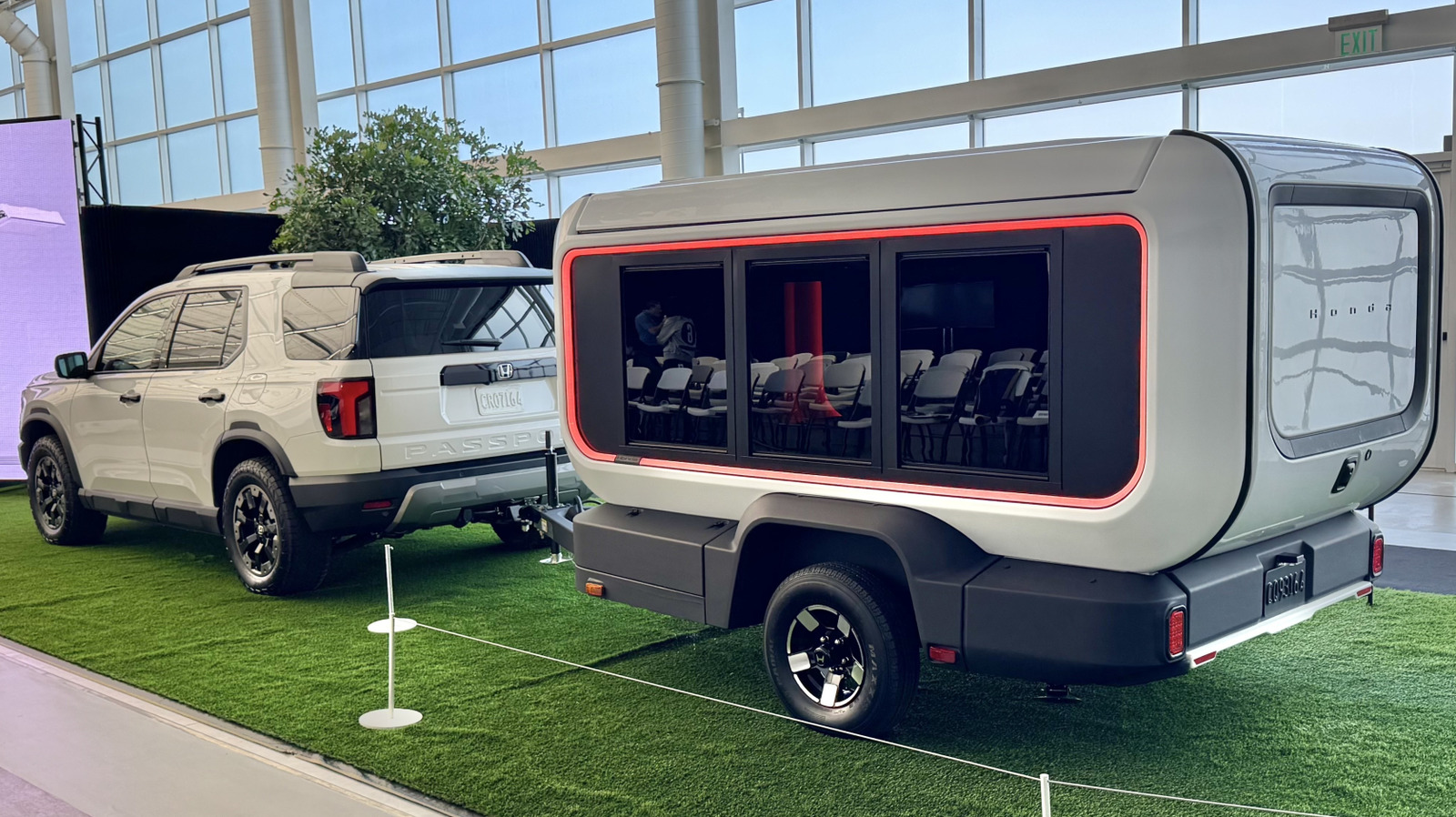
Honda unveiled a prototype camping trailer, the Base Station, targeting a curb weight under 1,400 pounds with an expandable lithium battery charged by solar, modular amenities (cooktop, sink, A/C, shower), a pop-up roof offering seven feet of clearance, and sleeping for four; the compact unit is designed to fit a standard garage and will be sold through Honda dealerships if greenlit. Honda positions the trailer to be competitively priced against small trailers that typically range from $17,000 to $50,000, signaling a potential lifestyle-product expansion by its U.S. team though commercialization and final pricing remain unconfirmed.
Market structure: Honda's Base Station prototype targets the $17k–$50k small-trailer segment with a curb weight <1,400 lbs and implied aim at a sub-$25k MSRP; winners are Honda (HMC) brand extension, franchised dealers (AutoNation AN exposure), lightweight-material and mobile-solar/battery suppliers, while legacy RV OEMs (Winnebago WGO, Thor THO) that compete on scale and margin are at risk of pricing pressure over 12–36 months. Competitive dynamics: OEM-backed trailers sold through dealer networks compress margins for small independents and could force a 5–15% price deflation in entry-level segments if Honda captures 5–10% share of U.S. small-trailer demand within 2–3 years. Supply/demand: incremental demand for small lithium packs and portable solar is modest but directional; raw-material demand could lift aluminum/composite premiums by 1–3% locally if adoption scales. Cross-asset: minimal FX effects; modest upward pressure on industrial credit spreads for specialty RV suppliers; commodity sensitivity centered on aluminum and battery metals, not broad oil/rail flows.
Risk assessment: tail risks include regulatory recall/fire risk for integrated lithium batteries, dealer resistance or franchise-law friction, and EV towing-range backlash—each could derail adoption within 3–18 months. Short-term catalysts are product confirmation, published MSRP and supplier disclosures (expect within 3–9 months); long-term adoption hinges on towing-range improvements and dealer rollouts over 12–36 months. Hidden dependencies: towing compatibility with mainstream EVs (range loss >20% will cap addressable market) and dealer lot economics. Monitor triggers: MSRP < $25k, battery kWh, number of dealerships carrying unit (>500) as binary move points.
Trade implications: direct tactical shorts in stand-alone RV OEMs (WGO, THO) sized 1.5–3% each look attractive if Honda confirms production/pricing, with 3–6 month put protection; pair trades (long HMC 1–2% vs short WGO 2%) capture brand-vs-legacy dynamics. Options: buy 3–9 month 10% OTM puts on WGO/THO (size = 50% of short notional) and consider 9–12 month call spreads on ENPH or SEDG to play mobile solar upside (1% risk allocation). Sector tilt: trim pure-play RV exposure and rotate 1–3% into automotive OEMs and select materials/solar names; enter small positions now, scale on confirmed MSRP/supplier announcements within 3–9 months.
Contrarian angles: consensus may overstate immediate disruption—Honda may limit volume or price to protect dealer economics, meaning short positions could underperform for 6–12 months; conversely, Honda could expand total market, lifting component suppliers (an underpriced positive). Historical parallels: OEM vertical extensions (e.g., branded accessories) often compress independents but expand adjacent parts demand; mispricing risk occurs if the market prices WGO/THO as binary losers today. Unintended consequences include dealer financing driving higher accessory attach rates (positive for credit income) and negative PR on EV towing reducing uptake—set clear triggers (MSRP, dealer count, measured range impact >20%) before scaling exposure.
AI-powered research, real-time alerts, and portfolio analytics for institutional investors.
Request DemoOverall Sentiment
moderately positive
Sentiment Score
0.45
