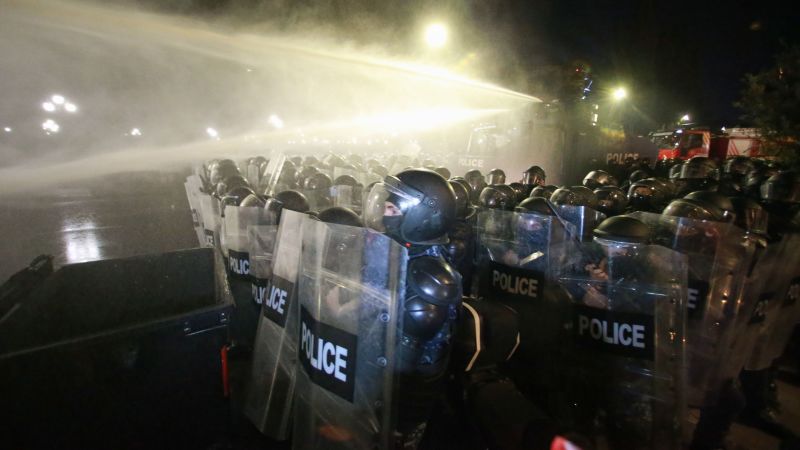
Georgian police deployed water cannons and pepper spray against protesters attempting to storm the presidential palace in Tbilisi, amid a municipal election boycotted by opposition parties. Tens of thousands rallied against the ruling Georgian Dream party, accusing it of undermining democratic aspirations, halting EU membership talks, and implementing repressive policies reminiscent of Russia. This escalating political unrest and government crackdown on dissent signals growing instability and potential geopolitical shifts in Georgia, raising concerns about governance and rule of law.
Police in Georgia used water cannons and pepper spray on Saturday to push back protesters who tried to storm the presidential palace, as the South Caucasus country held a municipal election boycotted by the main opposition blocs amid a sweeping crackdown on dissent. Tens of thousands rallied in the capital, Tbilisi, to protest repressive policies by the governing party, Georgian Dream, which they see as trying to pull Georgia away from its democratic aspirations and into Russia’s orbit. They carried Georgian flags and placards supporting membership in the European Union, a cherished goal for many that has been enshrined in the country’s constitution. Georgian Dream halted talks about joining the bloc last year, triggering waves of protests that have been met with mass arrests and police violence. The move came after the longtime ruling party declared victory in an election the opposition said was rigged. The rallies, big and small, have continued despite a multipronged crackdown by the government through laws that target demonstrators, rights groups, nongovernmental organizations and independent media. Critics say some have been modeled on legislation passed in Russia, where President Vladimir Putin has harshly stifled dissent. “We fight for our rights, for independence,” protester Sophio Asatiani told The Associated Press on Saturday. She said that she didn’t want to see a return to the Soviet era, when Georgia was ruled from Moscow. The rally’s organizers, including veteran opera singer Paata Burchuladze, called on protesters to “take power back into the hands of the people,” channelling widespread frustration with a government that has jailed key opposition figures, attempted to shut down critical media and used mass arrest and steep fines against largely peaceful demonstrators. Some then tried to force entry into the presidential palace in central Tbilisi, smashing the gate before being driven away by riot police. The opposition had promised a “peaceful revolution” before Saturday’s municipal election, boycotted by most parties critical of Georgian Dream. Preliminary data from the Central Election Commission pointed to less than 30% turnout in the first half of the day. Giorgi Rukhadze, a political analyst in Tbilisi who was one of the protesters marching on Saturday, dismissed the vote as a “mock election.” “The only way to put (Georgian Dream) out of power peacefully is non-obedience, noncompliance,” he said, arguing that people should join any forms of peaceful protests available to them. Georgian police on Saturday said the ongoing rally violated Georgian laws that regulate public assemblies and protest. It didn’t provide specifics. Georgia is experiencing a severe escalation in political instability, characterized by widespread public protests against the ruling Georgian Dream party and a forceful government crackdown. The use of water cannons and pepper spray on tens of thousands of demonstrators in Tbilisi, coupled with an opposition boycott of municipal elections which saw turnout below 30% in early reporting, signals a deep crisis of political legitimacy. The core driver of the unrest is the government's perceived pivot towards Russia's sphere of influence, evidenced by its halt of EU accession talks—a constitutionally-enshrined goal—and the implementation of repressive laws targeting media and NGOs, which critics claim are modeled on Russian legislation. This breakdown in governance, which includes the jailing of opposition figures, creates a highly uncertain operating environment. The situation is not merely domestic political turmoil but a significant geopolitical event that heightens sovereign risk for Georgia, as reflected by the strongly negative sentiment and high market impact score.
AI-powered research, real-time alerts, and portfolio analytics for institutional investors.
Request DemoOverall Sentiment
strongly negative
Sentiment Score
-0.80
