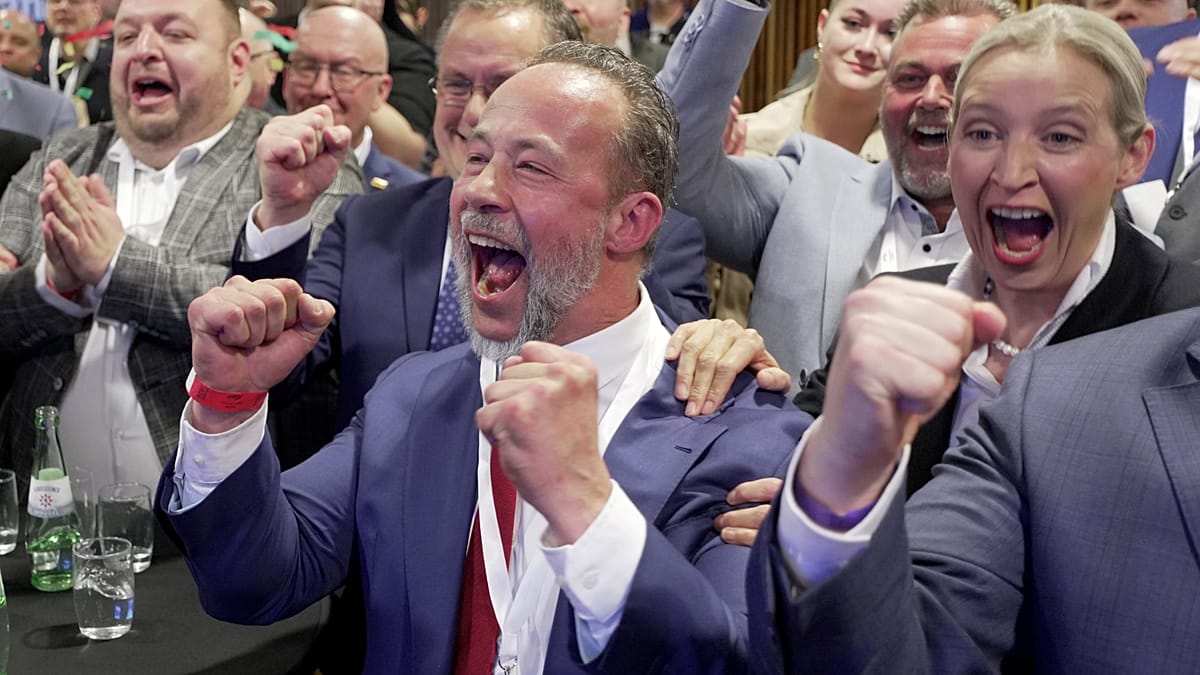
CDU leads Rhineland-Palatinate with 30.6% and is projected to provide the next state premier, while the SPD trails at 25.7% after dropping ~9 percentage points; AfD posts ~20% (up >11pp) and Greens register 7.9%. Only four parties (CDU, SPD, AfD, Greens) are projected to enter the state parliament; FDP (~2%) and Left (~4%) miss the threshold. CDU victory boosts federal CDU rhetoric of a national "tailwind" and points to a likely grand coalition with the SPD; SPD leadership has announced internal personnel debates following the setback.
This state result is best read as a step change in political tail-risk rather than an immediate policy pivot — the market will price a higher probability of episodic volatility in German assets over the next 3–12 months. Expect the 10y Bund term premium to show knee-jerk moves (order of 10–30bp intraday on headline shocks) and a potential 30–70bp widening in a sustained scenario where mainstream parties shift fiscal or security stances to counter the populist surge. That path is not linear: coalition negotiations and federal-level responses can both amplify and dampen these moves.
Corporate winners will be concentrated in two buckets: cyclical exporters and security/defense suppliers. Exporters benefit from a more business-friendly center-right tilt (higher capex probabilities, looser regulatory cadence), while defense/cybersecurity names are prime to capture incremental procurement and backlog growth with lead times of 6–12 months, which in turn lifts demand for specialty metals and electronics across supply chains. Conversely, green-policy-dependent developers face execution and subsidy-risk; their project IRRs are most sensitive to even modest policy re-calibrations.
The consensus is over-indexed to a binary “safe vs risky” read of German risk premia; the contrarian view is that most negative shocks are front-loaded and tradable if you hedge event volatility. Near-term catalysts that would reverse the surge include clear coalition commitments to centrist fiscal prudence, a rebound in SPD leadership credibility within 60–120 days, or a polling reversion ahead of federal-level tests. Tail events to prepare for are snap federal elections or a sudden re-pricing of EU sovereign spreads, both of which would materially reallocate cross-border capital flows into safe-haven assets.
AI-powered research, real-time alerts, and portfolio analytics for institutional investors.
Request DemoOverall Sentiment
neutral
Sentiment Score
0.00
