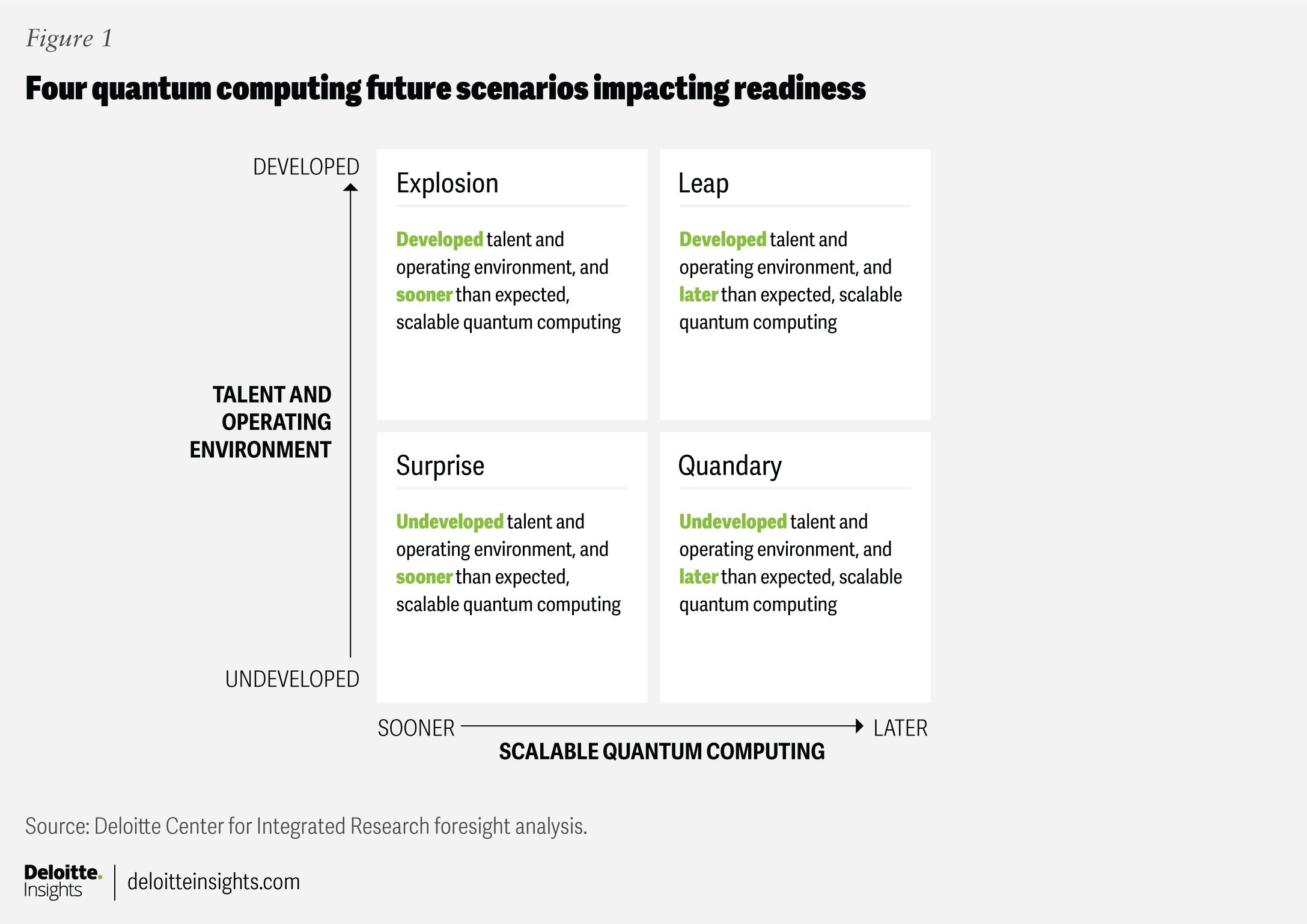
This piece underscores quantum computing's (QC) disruptive potential, particularly for investment management via advanced portfolio optimization and simulation capabilities, with commercial benefits anticipated by 2030. It warns against a "wait-and-see" approach, arguing that proactive strategic preparation—including talent development, roadmap creation, and ecosystem engagement—is critical now, regardless of exact commercialization timelines. The analysis of four plausible future scenarios consistently demonstrates that early movers will secure significant competitive advantages and mitigate risks like talent scarcity, while delayed action risks substantial competitive disadvantage.
Quantum computing (QC) is presented as a high-impact, long-term disruptive technology with vendors projecting tangible business benefits by 2030 and commercial scale within five to seven years. The critical technical inflection point is identified as the progression from approximately 50 reliable logical qubits today to a range of 200-1,000, which would enable enterprise-grade applications in portfolio optimization, materials science, and pharmaceuticals. The core thesis of the research is that a passive, 'wait-and-see' approach is a high-risk strategy, drawing parallels to the machine learning boom where late adopters struggled to acquire talent and infrastructure. Scenario analysis based on the dual uncertainties of talent availability and the pace of technological scaling consistently concludes that early movers—defined as those investing by 2025—will secure significant competitive advantages in talent acquisition, ecosystem influence, and intellectual property. Conversely, laggards face substantial risks, including being locked out of vendor partnerships and facing acute talent shortages. An immediate, tangible threat highlighted is the need for post-quantum cryptography (PQC) to secure data against future decryption capabilities, demanding attention irrespective of the broader QC commercialization timeline.
AI-powered research, real-time alerts, and portfolio analytics for institutional investors.
Overall Sentiment
moderately positive
Sentiment Score
0.40
